ESA

The points of the various landings made by the lander Philae on the surface of comet 67P/Churyumov-Gerasimenko

An article published in the journal “Nature” reports a reconstruction of the trajectory of ESA’s Rosetta mission’s Philae lander in its touchdown on the surface of comet 67P/Churyumov-Gerasimenko. A team of researchers examined data collected by the Rosetta space probe and the Philae lander to find out where the latter made its second touchdown on the comet, which was followed by further bounces before finally landing. The study also showed that the affected materials contained an abundant amount of ice as soft as freshly laid snow, to the point of being described as softer than cappuccino froth.

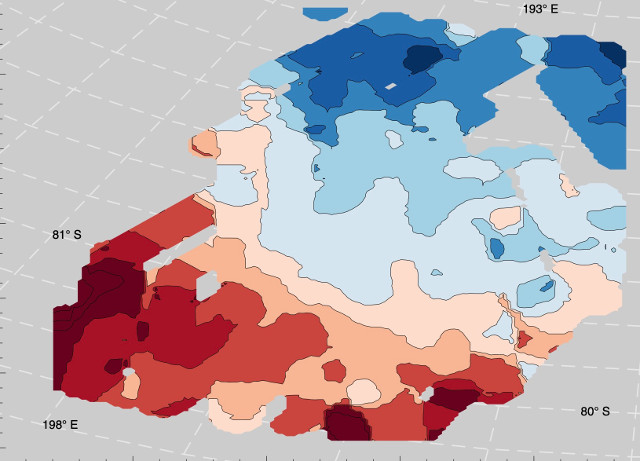
Radar map of the Mars area where the lake system was found (Image courtesy Sebastian Emanuel Lauro et al. Nature Astronomy, 2020)

An article published in the journal “Nature Astronomy” reports the discovery of new underground lakes of very salty liquid water under the planet Mars’ south pole cap. A team of researchers led by Elena Pettinelli and Sebastian Lauro, both of the Italian Roma Tre University, used data collected by ESA’s Mars Express space probe’s Mars Advanced Radar for Subsurface and Ionosphere Sounding (MARSIS) instrument to discover what form a lake system consisting of three main lakes surrounded by other smaller lakes. This confirms the discovery of a lake announced in July 2018 and offers evidence that this is not a unique case. It remains an extreme environment, so it takes some speculation to imagine life forms in those lakes, but the authors of this new research also recommend increasing the exploration of those areas to understand their potential is to host life.

Scheme of the CONSERT radar's work

An article published in the journal “Monthly Notices of the Royal Astronomical Society” reports a study indicating that the interior of the nucleus of comet 67P/Churyumov-Gerasimenko is porous and less dense than its surface. A team of researchers reviewed data collected by ESA’s Rosetta space probe and its Philae lander’s CONSERT instrument. The signals exchanged between them through the cometary nucleus propagated at different speeds, indicating a varying density of its interior. This suggests that solar radiation changed the surface, making it less porous.

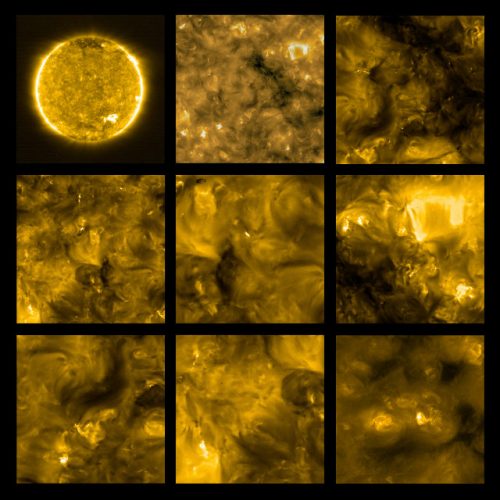
The Sun and its campfires seen by Solar Orbiter

ESA and NASA have published images captured by the Solar Orbiter space probe during its first Sun flyby. In this case, flying by means at a distance of about 77 million kilometers (48 million miles). During that maneuver, all its instruments were active after they were tested and commissioned despite the problems resulting from the Covid-19 pandemic with the difficulties for mission engineers and scientists. Among the first images, there are the ones of the so-called campfires, eruptions that are small by solar standards but are larger than many Earth nations.

Jezero Crater on Mars

Two articles published in the journal “Icarus” report as many studies on Jezero Crater on Mars. Two teams of researchers used data collected by ESA’s Mars Express space probe to reconstruct various parts of the history of Jezero Crater which, with its approximately 49 kilometers in diameter, in the past used to host a lake. It dried out long ago, but left traces such as clay materials that only form in the presence of water. The diversity of minerals is also due to an ancient volcanic activity that affected the entire region. NASA’s Mars 2020 mission, with the Mars Rover Perseverance, will land in Jezero Crater, if all goes well, in February 2021 to also look for possible traces of life, present or past.