ESA

SpaceX's Crew Dragon Endeavour spacecraft docked to the International Space Station (Image NASA TV)

A little while ago, SpaceX’s Crew Dragon Endeavour spacecraft docked to the International Space Station’s Harmony module completing the first part of its Crew-2 or SpaceX Crew-2 mission that began yesterday with its launch. After checking that the pressure is correctly balanced, the hatch will be opened to allow Thomas Pesquet, Megan McArthur, Shane Kimbrough, and Akihiko Hoshide to enter the Station.

SpaceX's Crew Dragon Endeavour spacecraft blasting off atop a Falcon 9 rocket (Image NASA TV)

A little while ago, SpaceX’s Crew Dragon Endeavour spacecraft blasted off atop a Falcon 9 rocket from Cape Canaveral in its Crew-2 o SpaceX Crew-2 mission. After about eleven minutes, it successfully separated from the rocket’s last stage and went en route to carry out its mission. This is the second crewed mission of the Crew Dragon spacecraft within the normal rotation of the International Space Station crew, the third one overall. This is also the second mission for the Endeavour, used also for the SpX-DM2 mission.

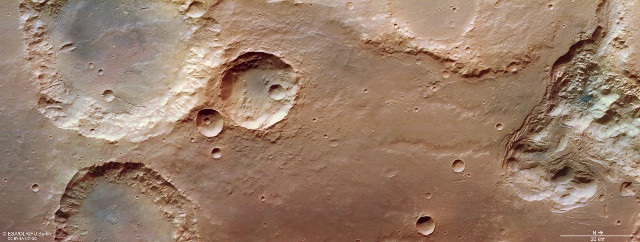
Chaotic terrain in Mars Pyrrhae Regio seen by Mars Express

ESA has released new images captured by its Mars Express space probe’s High Resolution Stereo Camera (HRSC) in Pyrrhae Regio, a region close to the Valles Marineris system on planet Mars. This is what is called chaotic terrain of the kind that forms when there’s underground ice that melts causing large amounts of water to be released. Such a process requires a significant amount of heat, which may have been provided by volcanic activity or a meteor impact. The current look is what is left after the water drained away, leaving in particular the geological formations called mesas.

The Sentinel-6A Michael Freilich satellite blasting off atop a Falcon 9 rocket (Image NASA TV)

A short time ago, the Sentinel-6A Michael Freilich satellite was launched atop a Falcon 9 rocket from the Vandenberg base. After almost exactly an hour, it successfully separated from the rocket’s last stage and set off on its course to reach the polar orbit at 1,336 kilometers altitude where its scientific mission will begin.

This mission is a collaboration between NASA, ESA, EUMETSAT, and NOAA. For this reason, it was named Michael Freilich after the former Director of NASA’s Earth Science Division, who passed away on August 5, 2020, alongside NASA’s Jason satellites and at the same time is part of ESA’s Copernicus program.

The crater triplet in Noachis Terra (Image ESA/DLR/FU Berlin, CC BY-SA 3.0 IGO)

ESA has published photos taken by its Mars Express space probe’s High Resolution Stereo Camera (HRSC) of a crater triplet in the Noachis Terra region on planet Mars. That region gave its name to the Noachian era in which, between about 3.7 and 4.1 billion years ago, the red planet was hit by a particularly large number of meteorites, and Noachis Terra is full of craters still existing. A crater triplet with an overlap indicating three very close impacts is interesting not only as a curiosity but also for the geological history it can tell together with others from the same region.