ESA

Rho Ophiuchi cloud complex viewed by Herschel and Planck (Image ESA/Herschel/Planck; J. D. Soler, MPIA)

An article published in the journal “Astronomy & Astrophysics” reports a study of the magnetic fields of molecular clouds to understand their influence in the processes that lead to star formation. Astronomer Juan D. Soler of the Max Planck Institute for Astronomy in Heidelberg, Germany, used data collected by the Planck Surveyor space probe during its mission and the Herschel space telescope during the Gould Belt Survey to investigate the characteristics of the interstellar medium and especially molecular clouds. The study was published in 2019, but more spectacular images have been published by ESA of combined views of molecular clouds.

Ascuris Planum seen by Mars Express

ESA has published photos of the plateau called Ascuris Planum on the planet Mars captured by the Mars Express space probe’s High Resolution Stereo Camera (HRSC). The landscape is full of fractures, deep scars generated by intense and prolonged tectonic forces that acted on the red planet for hundreds of millions of years. Those fractures are the extensions of the troughs existing in the area called Tempe Fossae, in the region called Tempe Terra, north-east of the vast region of Tharsis, where in ancient times active volcanoes generated enormous stress in the Martian crust and consequently the tectonic horst and graben visible today.

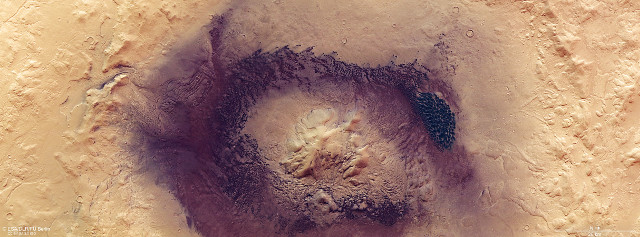
Moreux Crater on Mars

ESA has released new photos of Moreux Crater on the planet Mars taken by the Mars Express space probe’s High Resolution Stereo Camera (HRSC). It’s an impact crater, but shows characteristics that are out of normal, considered the result of erosion caused by glacial processes. Glaciations probably occurred in different periods since the geological traces present in the area suggest that they occurred even in the last millions of years. Another reason for interest in this crater is the presence of dunes inside it, which provide information on the winds blowing in the area.

The Solar Orbiter space probe blasting off atop an Atlas V rocket (Photo ESA - S. Corvaja)

A few hours ago the Solar Orbiter space probe blasted off atop an Atlas V rocket from Cape Canaveral. After about 53 minutes, it successfully separated from the rocket’s last stage and began the long journey that will take it up to about 42 million kilometers from the Sun. A little later it deployed its solar panels and started communicating with the mission control center.

Christina Koch, Alexander Skvortsov and Luca Parmitano assisted after their landing (Image NASA TV)

A little while ago astronauts Luca Parmitano and Christina Koch and cosmonaut Alexander Skvortsov returned to Earth on the Soyuz MS-13 spacecraft, that landed in Kazakhstan. Parmitano and Skvortsov spent a bit more than 6 months on the International Space Station, where they arrived on July 20, 2019 as part of Expedition 60, while Christina Koch arrived on March 15, 2019 as part of Expedition 59 and accomplished a long mission.