ESA

The Solar Orbiter space probe blasting off atop an Atlas V rocket (Photo ESA - S. Corvaja)

A few hours ago the Solar Orbiter space probe blasted off atop an Atlas V rocket from Cape Canaveral. After about 53 minutes, it successfully separated from the rocket’s last stage and began the long journey that will take it up to about 42 million kilometers from the Sun. A little later it deployed its solar panels and started communicating with the mission control center.

Christina Koch, Alexander Skvortsov and Luca Parmitano assisted after their landing (Image NASA TV)

A little while ago astronauts Luca Parmitano and Christina Koch and cosmonaut Alexander Skvortsov returned to Earth on the Soyuz MS-13 spacecraft, that landed in Kazakhstan. Parmitano and Skvortsov spent a bit more than 6 months on the International Space Station, where they arrived on July 20, 2019 as part of Expedition 60, while Christina Koch arrived on March 15, 2019 as part of Expedition 59 and accomplished a long mission.

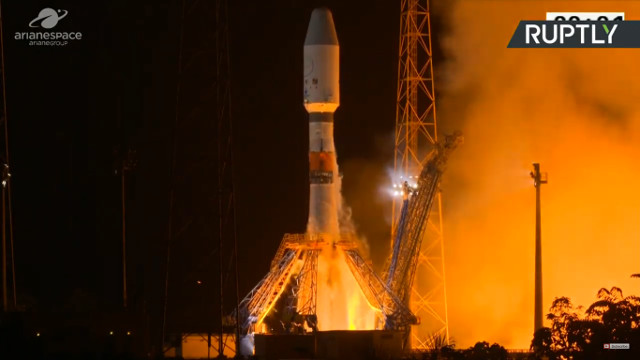
CHEOPS and Cosmo-SkyMed Second Generation blasting off atop aSoyuz rocket (Image courtesy Arianespace)

A few hours ago a Soyuz rocket was launched from the Kourou base, in French Guiana. After about 23 minutes the Cosmo-SkyMed Second Generation satellite successfully separated from the rocket’s Fregat last stage. About 85 minutes after the launch, the CHEOPS space telescope successfully separated from the rocket’s Fregat last stage.

The COSMO-SkyMed Second Generation satellite is the first of a constellation of two satellites that aims to replace the first generation’s four satellites. It’s a system of radar satellites for the territory observation, the result of a collaboration between the Italian Space Agency and the Italian Ministry of Defense.

The purpose of ESA’s CHEOPS (Characterizing ExOPlanets Satellite) space telescope is to conduct follow-up study of exoplanets using the transit method, which means observing the ones that pass in front of their star.

Remains of glaciers that sculpted the territory of Deuteronilus Mensae on Mars

ESA has published new images of the region of the planet Mars called Deuteronilus Mensae captured by its Mars Express space probe’s High Resolution Stereo Camera (HRSC) instrument that show a territory sculpted by the movements of glaciers that created formations such as those known as mesas. That’s a particularly interesting region because already in the last decade traces of ice still there were discovered. In the past, there was perhaps a regional ice cap in that area of ​​which Deuteronilus Mensae represents the remains.

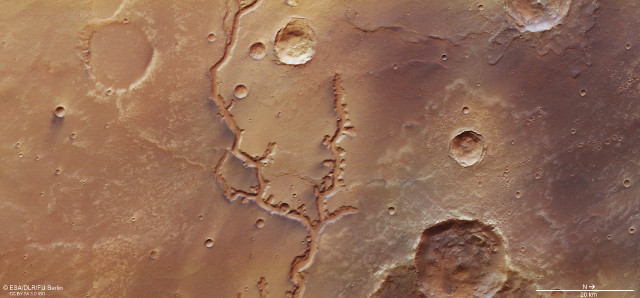
Nirgal Vallis on Mars (Image ESA/DLR/FU Berlin, CC BY-SA 3.0 IGO)

ESA has released new images captured by its Mars Express space probe’s High Resolution Stereo Camera (HRSC) showing Nirgal Vallis on the planet Mars. It’s a river valley that extends for over 700 kilometers, so vast that it crosses the Coprates and Margaritifer Sinus quadrangles. A few billion years ago, when the rivers were filled with liquid water, they probably filled Holden Crater, making it a lake with a diameter of about 150 kilometers and a depth of up to about 250 meters.