
ESA

The Soyuz MS-03 spacecraft blasting off atop a Soyuz Rocket (Photo NASA/Bill Ingalls)

It was night in Kazakhstan when the Soyuz MS-03 spacecraft blasted off from the Baikonur Cosmodrome in Kazakhstan carrying Peggy Whitson, Oleg Novitskiy and Thomas Pesquet to ransport them to the International Space Station. It’s the third new version Soyuz spacecraft and was launched once again in the route that will take two days instead of the six-hourt fast path to keep on testing the new on-board systems.

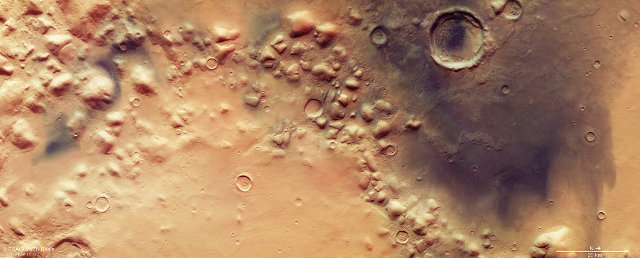
Part of Colles Nili (Photo ESA/DLR/FU Berlin, CC BY-SA 3.0 IGO)

Photos taken by ESA’s Mars Express space probe show the Colles Nili region on planet Mars. It’s very ancient geological feature that mark the boundaries between the northern lowlands and the southern highlands with the remains of ancient glaciers around them. They show signs of glaciations that occurred on Mars during the last few hundred million years.

Artistic representation of the Trace Gas Orbiter (TGO) (Image ESA–D. Ducros)

The ESA and Roscosmos’ TGO (Trace Gas Orbiter) space probe and the lander Schiaparelli have reached Mars completing the first phase of the first mission within the ExoMars program, started with their launch on March 14, 2016. Schiaparelli had separated from the TGO on October 16 with some thrill because the maneuver was successful but its telemetry data arrived with considerable delay.

Some outbursts on the comet 67P/Churyumov-Gerasimenko (Image OSIRIS: ESA/Rosetta/MPS for OSIRIS Team MPS/UPD/LAM/IAA/SSO/INTA/UPM/DASP/IDA; NavCam: ESA/Rosetta/NavCam – CC BY-SA IGO 3.0)

An article published in the journal “Monthly Notices of the Royal Astronomical Society” describes a research about the outbursts detected by ESA’s Rosetta space probe on the surface of the comet 67P/Churyumov-Gerasimenko. During the three months around its closest approach to the Sun, on August 13, 2015, Rosetta’s cameras captured 34 outbursts. A team led by Jean-Baptiste Vincent from the Max Planck Institute for Solar System Research in Gottingen, Germany, traced their origin on the comet’s surface.