ESA

Artistic representation of the Trace Gas Orbiter (TGO) (Image ESA–D. Ducros)

The ESA and Roscosmos’ TGO (Trace Gas Orbiter) space probe and the lander Schiaparelli have reached Mars completing the first phase of the first mission within the ExoMars program, started with their launch on March 14, 2016. Schiaparelli had separated from the TGO on October 16 with some thrill because the maneuver was successful but its telemetry data arrived with considerable delay.

Some outbursts on the comet 67P/Churyumov-Gerasimenko (Image OSIRIS: ESA/Rosetta/MPS for OSIRIS Team MPS/UPD/LAM/IAA/SSO/INTA/UPM/DASP/IDA; NavCam: ESA/Rosetta/NavCam – CC BY-SA IGO 3.0)

An article published in the journal “Monthly Notices of the Royal Astronomical Society” describes a research about the outbursts detected by ESA’s Rosetta space probe on the surface of the comet 67P/Churyumov-Gerasimenko. During the three months around its closest approach to the Sun, on August 13, 2015, Rosetta’s cameras captured 34 outbursts. A team led by Jean-Baptiste Vincent from the Max Planck Institute for Solar System Research in Gottingen, Germany, traced their origin on the comet’s surface.

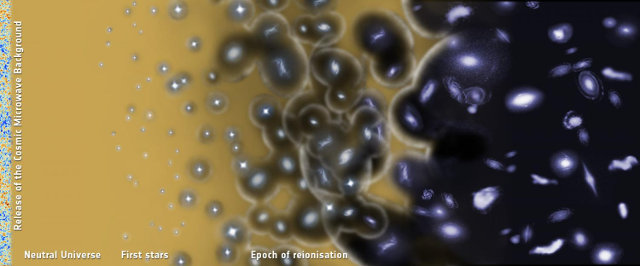
Artist's impression of a portion in the timeline of the Universe, around the epoch of reionization (Image ESA – C. Carreau)

Two articles published in the journal “Astronomy and Astrophysics” describe the latest updates regarding the analysis of the data collected by ESA’s Planck Surveyor space probe between 2009 and 2013. The latest results show that the first stars started forming about 700 million years after the Big Bang, about 150 million years later than earlier analyzes indicated.