ESA

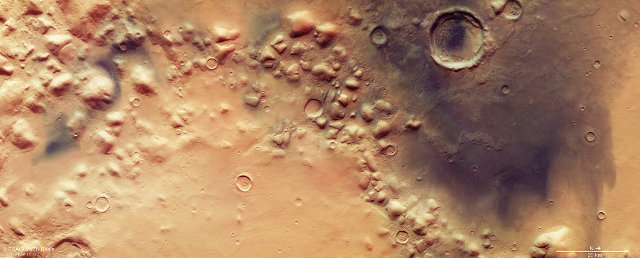
Adamas Labyrinthus (Photo ESA/DLR/FU Berlin, CC BY-SA 3.0 IGO)

ESA has published a photograph of a sort of labyrinth that is part of a region called Adamas Labyrinthus on Mars taken by the Mars Express space probe. This region is in turn part of Utopia Planitia, a huge impact basin with an estimated diameter of about 3,300 kilometers. The fractures in Adamas Labyrinthus create a system of polygonal shapes that might have originated from fine-grained sediments that were once at the bottom of an ocean.

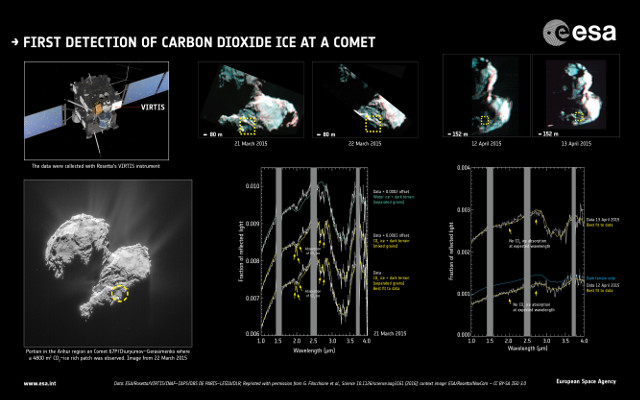
Dry ice detected with its spectral data and indication of the area (Image Data: ESA/Rosetta/VIRTIS/INAF-IAPS/OBS DE PARIS-LESIA/DLR; Reprinted with permission from G. Filacchione et al., Science 10.1126/science.aag3161 (2016); context image: ESA/Rosetta/NavCam – CC BY-SA IGO 3.0)

Two articles published in the journal “Science” describe the discovery of dry ice, meaning frozen carbon dioxide, on the surface of the comet 67P/Churyumov-Gerasimenko. A team of researchers led by Gianrico Filacchione of the Italian National Institute for Astrophysics and another led by Sonia Fornasier the French LESIA-Observatoire de Paris and Université Paris Diderot used the observations conducted with the VIRTIS spectrometer aboard ESA’s Rosetta space probe to find for the first time dry ice on a comet’s nucleus.

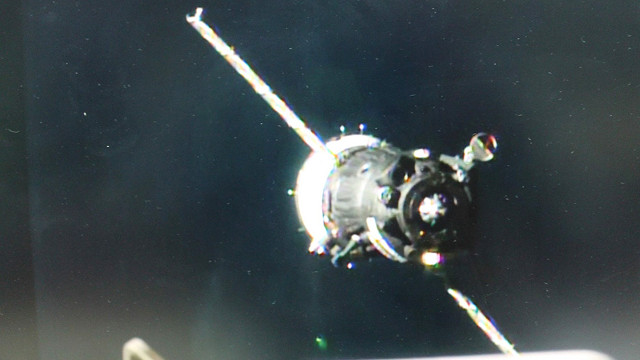
The Soyuz MS-03 spacecraft blasting off atop a Soyuz Rocket (Photo NASA/Bill Ingalls)

It was night in Kazakhstan when the Soyuz MS-03 spacecraft blasted off from the Baikonur Cosmodrome in Kazakhstan carrying Peggy Whitson, Oleg Novitskiy and Thomas Pesquet to ransport them to the International Space Station. It’s the third new version Soyuz spacecraft and was launched once again in the route that will take two days instead of the six-hourt fast path to keep on testing the new on-board systems.

Part of Colles Nili (Photo ESA/DLR/FU Berlin, CC BY-SA 3.0 IGO)

Photos taken by ESA’s Mars Express space probe show the Colles Nili region on planet Mars. It’s very ancient geological feature that mark the boundaries between the northern lowlands and the southern highlands with the remains of ancient glaciers around them. They show signs of glaciations that occurred on Mars during the last few hundred million years.