
ESA

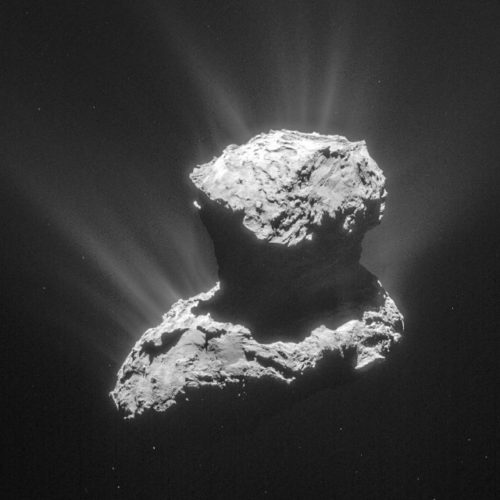
The comet 67P/Churyumov-Gerasimenko photographed on March 25, 2015, one of the moments of the organic molecules detections (Photo ESA/Rosetta/NavCam – CC BY-SA IGO 3.0)

An article published in the journal “Science Advances” describes the discovery of ingredients that are considered key to the origin of life on Earth on the comet 67P/Churyumov-Gerasimenko. In particular, glycine, an amino acid found in proteins, and phosphorus, an element that forms DNA and cell membranes. These observations were made by the ROSINA instrument aboard ESA’s Rosetta space probe.

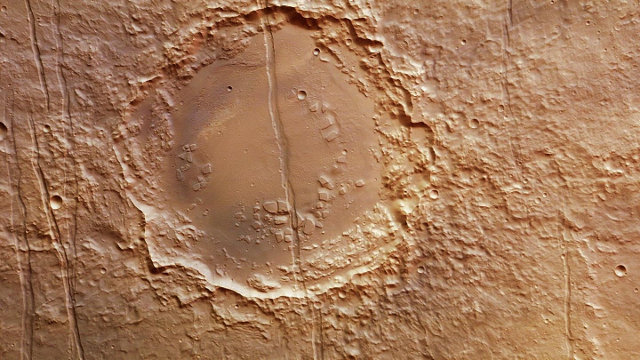
Crater in Memnonia Fossae (Image DLR)

The German space agency DLR published photos of a curious crater marked by a deep rift that splits it in two in the area of ​​Mars called Memnonia Fossae. These are photos taken by the High Resolution Stereo Camera (HRSC), one of the instruments of ESA’s Mars Express space probe.

The Sentinel-1B satellite blasting off atop a Soyuz-STA rocket (Photo ESA–Manuel Pedoussaut)

A few hours ago, the Sentinel-1B satellite, part of the Copernicus / GMES, was launched from the Kourou spaceport, in French Guiana, on a Soyuz-STA/Fregat-M rocket. After about 25 minutes, the satellite regularly separated from the rocket’s last stage and started sending signals. Along with it some nanosatellites of the CubeSat type and the Microscope microsatellite of the French space agency CNES were launched.

The center of the Milky Way seen by the Herschel Space Telescope (ESA/Herschel/PACS, SPIRE/Hi-GAL Project. Acknowledgement: G. Li Causi, IAPS/INAF, Italy)

An article published in the journal “Astronomy & Astrophysics” presents maps and a catalog of compact sources obtained thanks to a project called Herschel infrared Galactic Plane Survey (Hi-GAL). The observations made during the ESA Herschel Space Telescope’s mission were used to create maps of the complete Plan Galactic in the far infrared with a level of completeness never seen before.

Artistic concept of the Venus Express space probe during an aerobraking maneuver (Image ESA–C. Carreau)

An article published in the journal “Nature Physics” describes an analysis of the data collected by ESA’s Venus Express space probe during the final phase of its mission. After about eight years orbiting the planet Venus, in 2014 it was sent down lower and lower into the atmosphere, where it collected many new data before ending up getting destroyed. This allowed for example to discover the extraordinarily low temperatures of some atmospheric waves that have an average of about -157° Celsius (about -250° Fahrenheit).