ESA

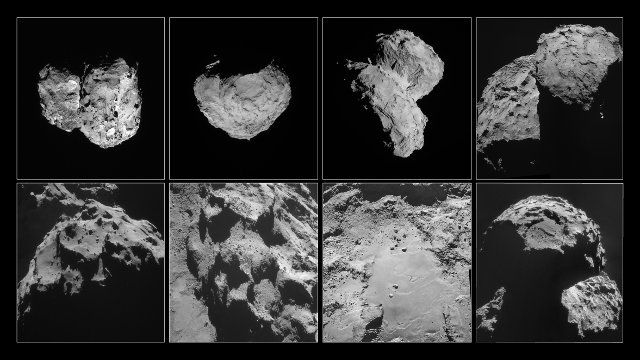
Pictures of the comet 67P/Churyumov-Gerasimenko taken by the Rosetta space probe between August and November 2014 (Image ESA/Rosetta/NavCam – CC BY-SA IGO 3.0)

An article published in the journal “Nature” describes a research about the internal structure of the comet 67P/Churyumov-Gerasimenko. A team of scientists, led by Martin Pätzold, from Rheinische Institut für Umweltforschung an der Universität zu Köln, Germany, analyzed data collected by ESA’s Rosetta space probe to provide some answers to the astronomers’ questions. According to their findings, the comet’s internal structure is quite homogeneous and contains no large caves. The total mass was estimated at nearly 10 billion tons.

Perspective view in Noctis Labyrinthus (Image ESA/DLR/FU Berlin, CC BY-SA 3.0 IGO)

ESA has published new photographs of Noctis Labyrinthus (labyrinth of the night), taken by its Mars Express space probe on July 15, 2015. It’s a mountain range in the western side of Valles Marineris, a huge complex of canyons on the planet Mars, near its equator. Its complex structures were created by the breaking of the crust of the Tharsis region, which caused deep fractures.

Photos of the Imhotep region on the comet 67P/Churyumov-Gerasimenko where water ice on the surface was confirmed (Image ESA/Rosetta/NavCam – CC BY-SA IGO 3.0)

An article published in the journal “Nature” describes research that led to the confirmation of the presence of water ice exposed on the surface of the comet 67P/Churyumov-Gerasimenko. The VIRTIS instrument on ESA’s Rosetta space probe recorded the data that were analyzed to determine the composition of the surface top layer, which is mainly a dark material, dried and rich in organic substances containing a small part of water ice. On the comet there’s a lot of ice but it’s interesting to examine that on the surface because it allows us to understand better some of its creation processes, even underground.

Photo of Enceladus' northern region showing the contrast between its areas (Image NASA/JPL-Caltech/Space Science Institute)

Some days ago, the Cassini space probe completed its last Enceladus flyby. It’s a Saturn’s moon very interesting for the presence of an underground ocean of liquid water. This time, Cassini passed about 5,000 kilometers (about 3,100 miles) from Enceladus measuring the heat flow from inside it and taking more pictures of its icy surface.

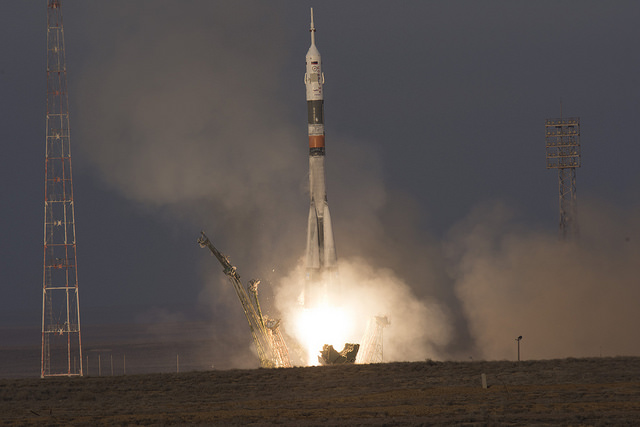
The SoyuzTMA-19M spacecraft blasting off atop a Soyuz rocket (Photo ESA-Stephane Corvaja)

A few hours ago the Soyuz TMA-19M spacecraft was launched from the Baikonur Cosmodrome in Kazakhstan and after about six anx a half hours reached the International Space Station carrying Tim Peake, Yuri Malenchenko and Tim Kopra. The Soyuz used the fast path normally used but it took a bit longer than anticipated because of a problem with the automatic docking system: as a consequence, the maneuver was conducted manually.