ESA

Photos of the Imhotep region on the comet 67P/Churyumov-Gerasimenko where water ice on the surface was confirmed (Image ESA/Rosetta/NavCam – CC BY-SA IGO 3.0)

An article published in the journal “Nature” describes research that led to the confirmation of the presence of water ice exposed on the surface of the comet 67P/Churyumov-Gerasimenko. The VIRTIS instrument on ESA’s Rosetta space probe recorded the data that were analyzed to determine the composition of the surface top layer, which is mainly a dark material, dried and rich in organic substances containing a small part of water ice. On the comet there’s a lot of ice but it’s interesting to examine that on the surface because it allows us to understand better some of its creation processes, even underground.

Photo of Enceladus' northern region showing the contrast between its areas (Image NASA/JPL-Caltech/Space Science Institute)

Some days ago, the Cassini space probe completed its last Enceladus flyby. It’s a Saturn’s moon very interesting for the presence of an underground ocean of liquid water. This time, Cassini passed about 5,000 kilometers (about 3,100 miles) from Enceladus measuring the heat flow from inside it and taking more pictures of its icy surface.

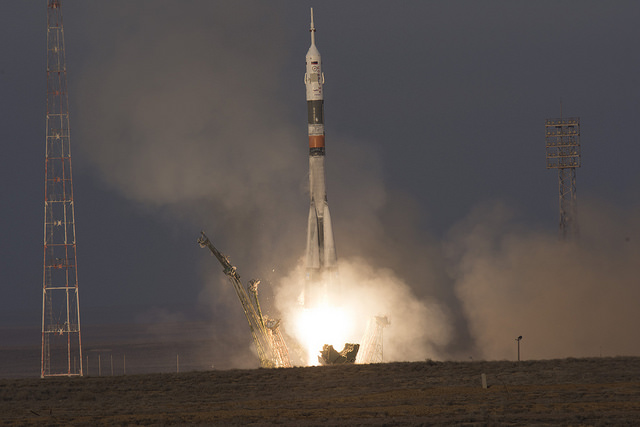
The SoyuzTMA-19M spacecraft blasting off atop a Soyuz rocket (Photo ESA-Stephane Corvaja)

A few hours ago the Soyuz TMA-19M spacecraft was launched from the Baikonur Cosmodrome in Kazakhstan and after about six anx a half hours reached the International Space Station carrying Tim Peake, Yuri Malenchenko and Tim Kopra. The Soyuz used the fast path normally used but it took a bit longer than anticipated because of a problem with the automatic docking system: as a consequence, the maneuver was conducted manually.

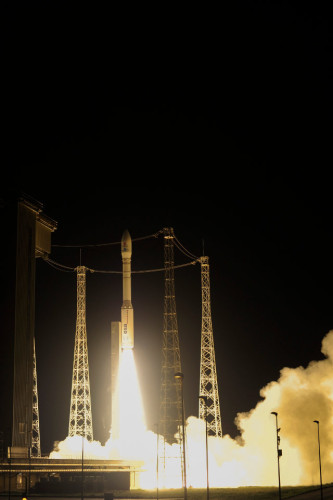
The LISA Pathfinder space probe blasting off atop a Vega rocket (Photo ESA–Stephane Corvaja)

A few hours ago ESA’s LISA Pathfinder space probe was successfully launched atop a Vega rocket from the Kourou space center in French Guiana. After about an hour and 45 minutes it separated from the rocket’s upper stage and activated to begin its long journey thanks to its propulsion module.

LISA Pathfinder entered an elliptical orbit where it will make a series of maneuvers that within a few weeks will take it to the area called L1, where the gravity of the Earth and the Sun get balanced with the other forces acting on the probe. The propulsion module will be disconnected after exhausting its function and the probe will remain in the L1 area, about 1.5 million kilometers (about 900,000 miles) from Earth.

The Orions spacecraft's service module built by ESA moved in the USA (Photo NASA)

NASA provided some new information about the first flight test for its Space Launch System (SLS) with the Orion spacecraft, called Exploration Mission-1 (EM-1). The agency did it in the occasion of the arrival to the Space Power Facility (SPF) in Sandusky, Ohio, of the test version of the Orion’s service module built by ESA known as European Service Module (ESM). This will allow NASA to begin testing the new spacecraft in its full configuration, a crucial step in the preparation of the EM-1 mission.