ESA

The Astro-H space telescope blasting off atop an H-IIA rocket (Image courtesy JAXA)

A little while ago the Japanese Astro-H space telescope was launched from the Tanegashima Space Center on a H-IIA rocket. After about fifteen minutes it regularly separated from the rocket’s last stage. It will reach the low-Earth orbit, where it will be positioned at an altitude of about 575 kilometers (about 357 miles).

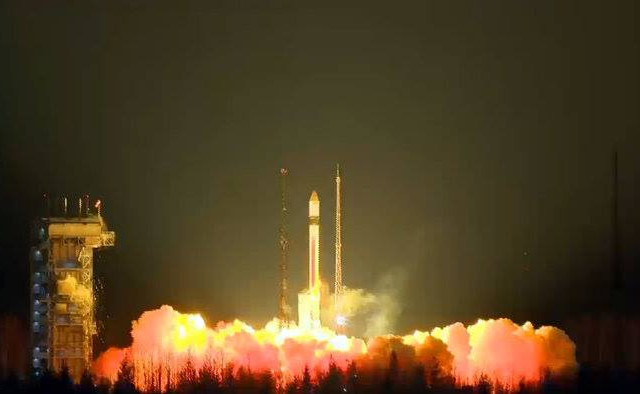
The Sentinel-3A blasting off atop a Rockot launch vehicle (Photo ESA)

A few hours ago the Sentinel-3A satellite, part of the GMES / Copernicus program, was launched from the Russian Plesetsk Cosmodrome on a Rockot launch vehicle. After about an hour and a half it separated from the rocket’s last stage, called Breeze KM, it started communicating with the control center and to deploy its solar panels. Its final orbit is Sun-synchronous, which means it will pass over a certain area of ​​the Earth at the same local time, with an altitude of about 815 kilometers (about 506 miles).

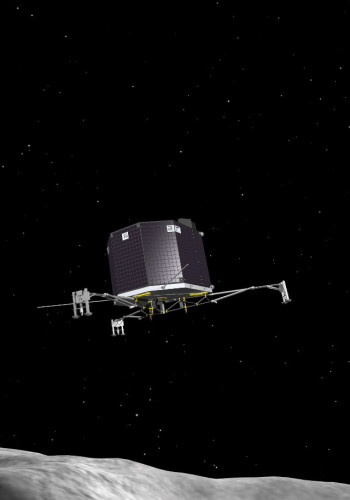
Artist's impression of the Philae lander (Image ESA–J. Huart)

The hopes to be able to contact the lander Philae on the comet 67P/Churyumov-Gerasimenko’s surface have now faded and ESA is also pessimistic. DLS, the German space agency, runs the LCC (Lander Control Center) and in recent months tried to re-establish contact after Philae communicated for a while on several occasions but issued a statement declaring that it’s time to say goodbye to the lander.

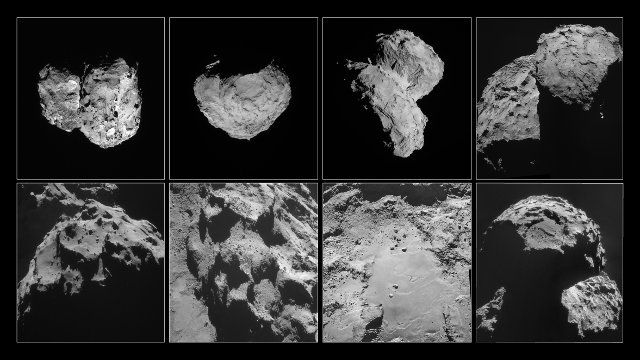
Pictures of the comet 67P/Churyumov-Gerasimenko taken by the Rosetta space probe between August and November 2014 (Image ESA/Rosetta/NavCam – CC BY-SA IGO 3.0)

An article published in the journal “Nature” describes a research about the internal structure of the comet 67P/Churyumov-Gerasimenko. A team of scientists, led by Martin Pätzold, from Rheinische Institut für Umweltforschung an der Universität zu Köln, Germany, analyzed data collected by ESA’s Rosetta space probe to provide some answers to the astronomers’ questions. According to their findings, the comet’s internal structure is quite homogeneous and contains no large caves. The total mass was estimated at nearly 10 billion tons.

Perspective view in Noctis Labyrinthus (Image ESA/DLR/FU Berlin, CC BY-SA 3.0 IGO)

ESA has published new photographs of Noctis Labyrinthus (labyrinth of the night), taken by its Mars Express space probe on July 15, 2015. It’s a mountain range in the western side of Valles Marineris, a huge complex of canyons on the planet Mars, near its equator. Its complex structures were created by the breaking of the crust of the Tharsis region, which caused deep fractures.