ESA

Aurorae Chaos and Ganges Chasma (Image ESA/DLR/FU Berlin, licence CC BY-SA 3.0 IGO)

ESA has published images of Valles Marineris on Mars captured by its Mars Express space probe in July 2015. It’s a huge complex of geological fractures much wider and longer than the American Grand Canyon. In particular, scientists focused on the photographs taken by Mars Express’ High Resolution Stereo Camera (HRSC) in an area called Aurorae Chaos, where there are still traces of ancient water flows.

Locations of 19 auroral detections (white circles) on Mars The data is superimposed on the magnetic field line structure where red indicates closed magnetic field lines, grading through yellow, green and blue to open field lines in purple (Image based on data from J-C. Gérard et al (2015))

Two articles, one published in “Journal of Geophysical Research: Space Physics” and one published in the journal “Icarus”, describe a research on ultraviolet auroras detected on Mars by ESA’s Mars Express space probe. Jean-Claude Gérard and Lauriane Soret of the University of Liege, Belgium, led a team of scientists who examined ten years of data that were analyzed to understand the mechanisms of creation of these auroras.

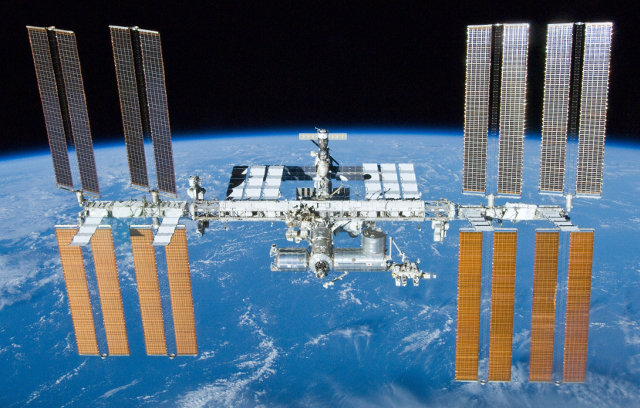
The International Space Station photographed by a space shuttle Atlantis crew member on May 23, 2010 (Photo NASA)

On November 2, 2000, the first three crew members reached the International Space Station to begin their work in what was then the new outpost of humanity. With that act, American astronaut Bill Shepherd and Russian cosmonauts Sergei Krikalev and Yuri Gidzenko established a continuous human presence there. Over the years, the Station has been expanded to take its current configuration developing wider and wider opportunities to do research that have brought and will bring various technological and scientific developments.

The comet 67P/Churyumov-Gerasimenko on October 18, 2015 (Photo ESA/Rosetta/NavCam)

An article just published in the journal “Nature” describes the discovery of oxygen molecules in the coma of the comet 67P/Churyumov-Gerasimenko. It’s a surprising discovery, and in fact is the first time that this presence is detected in a comet because molecular oxygen is very reactive so it tends to combine for example with hydrogen to form water. This oxygen is a “survivor” from the time of formation of the solar system.

The galaxy cluster MACS J0416.1–2403 observed by the Hubble Space Telescope (Image NASA, ESA and the HST Frontier Fields team (STScI))

An international team led by the astronomer Hakim Atek of the Ecole Polytechnique Fédérale de Lausanne, Switzerland, used the Hubble Space Telescope to observe over 250 dwarf galaxies that existed between 600 and 900 million years after the Big Bang. It’s one of the largest samples of dwarf galaxies discovered so far dating back to such a remote era and allows us to look into the universe at a young age providing useful information to understand its evolution.