ESA

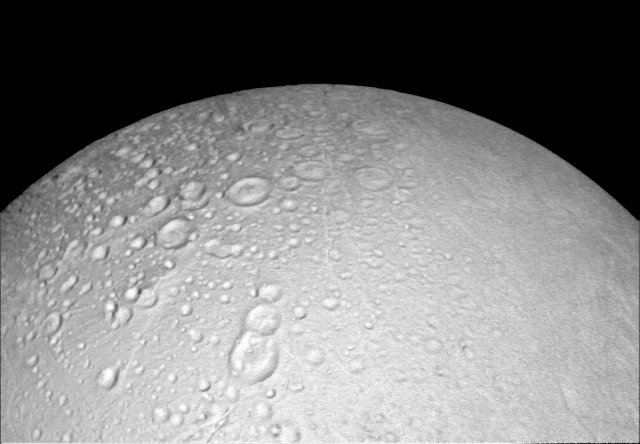
The area around Enceladus north pole with its many craters photographed by the Cassini space probe (Photo NASA/JPL-Caltech/Space Science Institute)

In recent days, the Cassini spacecraft made one of the closesest flybys with Enceladus, one of Saturn’s moons, passing at a distance of about 1,840 kilometers (almost 1,140 miles) from its surface. The first pictures received at the mission control center show that Enceladus north pole has many fractures in the ice crust that covers this moon but there are also thin cracks running through it and many craters around it.

Two pictures of Jupiter's surface taken by the Hubble Space Telescope (Image NASA, ESA, A. Simon (GSFC), M. Wong (UC Berkeley), and G. Orton (JPL-Caltech))

The Hubble Space Telescope was used to create new maps of the planet Jupiter. Hubble’s Wide Field Camera 3 captured a series of images of the planet within the Outer Planet Atmospheres Legacy program. The aim is to produce new maps every year and in the case of Jupiter 10 hours of daily shooting made it possible to discover new phenomena including changes in the Great Red Spot.

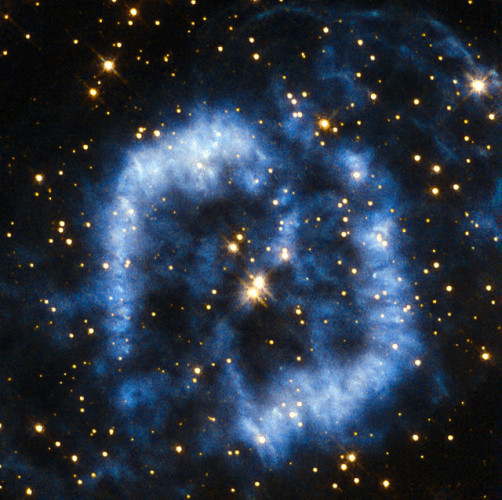
Picture of the Menzel 2 nebula taken by the Hubble space telescope (Image ESA/Hubble & NASA, acknowledgement: Serge Meunier)

The Hubble Space Telescope took a picture of the planetary nebula PK 329-02.2, also known as ESO 178-15 or Hen 2-150 and commonly called Menzel 2 (Mz 2) because it was discovered by the astronomer Donald Menzel in 1922. Distant little more 7,700 light years from Earth, it’s visible in the constellation Norma and is another case in which a planetary nebula offers a breathtaking show, in this case with a blue cloud that aligns with the two stars at its center.

On the left, OSIRIS images used to visually identify over 100 terraces (green). In the middle, a 3D shape model used to determine the directions in which the terraces/strata are sloping and to visualise how they extend into the subsurface. On the right, local gravity vectors visualised on the comet shape model perpendicular to the terrace/strata planes (Image ESA/Rosetta/MPS for OSIRIS Team MPS/UPD/LAM/IAA/SSO/INTA/UPM/DASP/IDA; M. Massironi et al (2015))

At the European Planetary Science Congress going on these days in Nantes, France, evidence were presented that the strange shape of the nucleus of comet 67P/Churyumov-Gerasimenko is due to the fact that it was born from the merger of two small comets occurred a few billion years ago. The study conducted by a team led by Matteo Massironi, a researcher at the University of Padua and Italian INAF (National Institute of Astrophysics) associate, was published in the journal “Nature”.

Maps of water ice abundance (left) and surface temperature (right) focusing on the Hapi ‘neck’ region of Comet 67P/Churyumov–Gerasimenko (Image ESA/Rosetta/VIRTIS/INAF-IAPS/OBS DE PARIS-LESIA/DLR; M.C. De Sanctis et al (2015))

An article just published in the journal “Nature” describes a research on the daily water-ice cycle on the surface of the comet 67P/Churyumov-Gerasimenko and its vicinity. A team of scientists led by Maria Cristina De Sanctis from Rome’s IAPS-INAF (National Institute of Astrophysics – Institute for Astrophysics and Space Planetology) analyzed data collected by the ESA’s Rosetta space probe’s VIRTIS spectrometer discovering that in some areas the ice water disappears in the day and reappears in the night.