
ESA

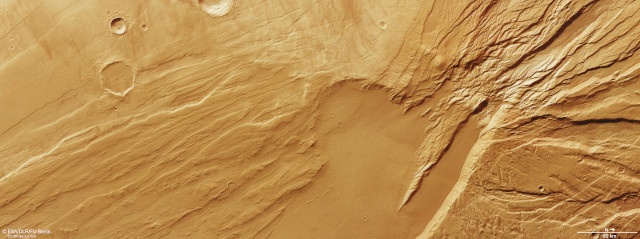
The area around the Acheron Fossae region on Mars

ESA has released images of the Acheron Fossae region on Mars captured by its Mars Express space probe’s High Resolution Stereo Camera (HRSC). The peculiarity of these images is that they show the two faces of Mars, meaning that they show how the red planet is basically divided into two parts with very different geological characteristics. About half of Mars is composed of an ancient terrain marked by craters and other signs of age and activity, while the other half is much smoother, with a surface probably reshaped by lava from volcanoes that are no longer active.

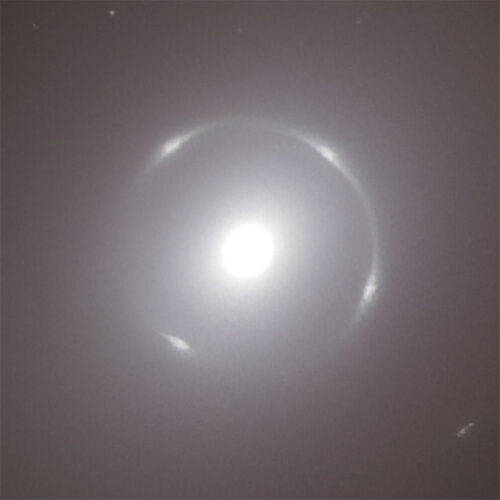
The Einstein ring around galaxy NGC 6505 (Image ESA/Euclid/Euclid Consortium/NASA, image processing by J.-C. Cuillandre, G. Anselmi, T. Li / CC BY-SA 3.0 IGO)

An article published in the journal “Astronomy & Astrophysics” reports the identification of a practically perfect so-called Einstein ring around the galaxy NGC 6505. A team of researchers Conor led by O’Riordan of the Max Planck Institute for Astrophysics in Munich, Germany, examined observations conducted with the Euclid space telescope to study the image of a much more distant galaxy distorted by the gravitational lens created by NGC 6505. This effect allows to study NGC 6505 as well because its mass creates that gravitational lens, so its effects allow to analyze it.

The Australe Scopuli region on Mars (Image ESA/DLR/FU Berlin (CC-BY-SA 3.0 IGO))

ESA has published reprocessed images of the Australe Scopuli region of Mars captured by its Mars Express space probe’s High Resolution Stereo Camera (HRSC). The area is covered in what appears to be snow but is actually carbon dioxide ice and dust. Despite the differences, the view is reminiscent of a Christmas landscape, especially the kind common at altitudes where it normally snows on Earth. It’s still a significant day because, on December 25, 2003, Mars Express entered Mars’ orbit.

Sentinel-1C satellite blasting off atop a Vecga-C rocket (Photo courtesy ESA-CNES-ARIANESPACE/Optique vidéo du CSG–S. Martin)

A few hours ago, the Sentinel-1C satellite, part of the Copernicus / GMES, was launched from the Kourou spaceport, in French Guiana, atop a Vega-C rocket. After about 1 hour and 44 minutes, the satellite regularly separated from the rocket’s last stage and started sending signals. Its final orbit in low Earth orbit will be at an altitude of about 693 kilometers.

The galaxy NGC 2090 as seen by the James Webb Space Telescope (ESA/Webb, NASA & CSA, A. Leroy)

ESA has published an image captured by the James Webb Space Telescope that portrays the galaxy NGC 2090 in the near and mid-infrared thanks to the combination of the MIRI (Mid-InfraRed Instrument) and NIRCam (Near-InfraRed Camera) instruments. This allowed to obtain an unprecedented amount of detail on this galaxy’s two spiral arms. For ESA, which participates in various astronomical missions, NGC 2090 is at the center of the scene these days because the choice for the Webb image of the month follows by a few days the choice for the Hubble Space Telescope image of the week, captured using various WFC3 (Wide Field Camera 3) instrument’s filters in the visible frequencies and an ultraviolet filter.