ESA

The galaxy NGC 2090 as seen by the James Webb Space Telescope (ESA/Webb, NASA & CSA, A. Leroy)

ESA has published an image captured by the James Webb Space Telescope that portrays the galaxy NGC 2090 in the near and mid-infrared thanks to the combination of the MIRI (Mid-InfraRed Instrument) and NIRCam (Near-InfraRed Camera) instruments. This allowed to obtain an unprecedented amount of detail on this galaxy’s two spiral arms. For ESA, which participates in various astronomical missions, NGC 2090 is at the center of the scene these days because the choice for the Webb image of the month follows by a few days the choice for the Hubble Space Telescope image of the week, captured using various WFC3 (Wide Field Camera 3) instrument’s filters in the visible frequencies and an ultraviolet filter.

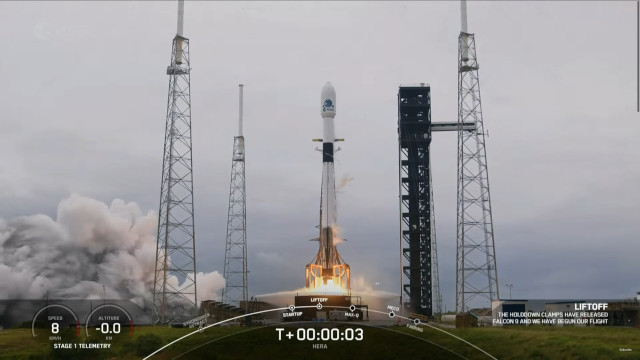
The Hera space probe blasting off atop a Falcon 9 rocket (Image courtesy SpaceX)

Yesterday, ESA’s Hera space probe blasted off atop a SpaceX Falcon 9 rocket from the Cape Canaveral together with the two nanosatellites Juventas and Milani. After about 76 minutes, it successfully separated from the rocket’s last stage and set on its course which in almost exactly two years will take it to the asteroid Didymos and its moon Dimorphos to examine the consequences of the impact of NASA’s DART spacecraft.

The Sentinel-2C satellite blasting off atop a Vega rocket (Image courtesy ESA-CNES-ARIANESPACE/Optique vidéo du CSG–S. Martin)

A few hours ago, the Sentinel-2C satellite of the Copernicus / GMES program blasted off from the Kourou base, French Guiana, atop a Vega rocket. After about 57 minutes, the satellite regularly separated from the rocket’s last stage and started sending signals. A few hours later it started deploying its solar panels. After a period of testing, it will replace the Sentinel-2A satellite, launched on June 23, 2015. This is the last launch of the original version of the Vega rocket.

The Caralis Chaos on Mars

An image captured by ESA’s Mars Express space probe’s High Resolution Stereo Camera (HRSC) shows the region of the planet Mars called Caralis Chaos. At first glance, it may seem like just another Martian area dotted with craters and wind-carved mounds, but when the red planet was young, it was home to Lake Eridania, larger than all the lakes on Earth. It covered an area of ​​more than a million square kilometers, including Atlantis Chaos, an area close to Caralis Chaos. That lake gradually dried up as the environmental collapse transformed an Earth-like planet into the one we see today.

The Ariane 6 rocket blasting off in its maiden flight (Image courtesy ESA)

A few hours ago the Ariane 6 rocket was launched from the base in French Guiana and conducted its maiden mission in the version with two side boosters. Over the course of approximately 2 hours and 40 minutes, the various phases of the flight were conducted, which among other things tested the great innovation of this rocket which consists of the possibility of restarting the Vinci engine which powers the upper stage. This new possibility allows it to place satellites in different orbits in the same mission.