ESA

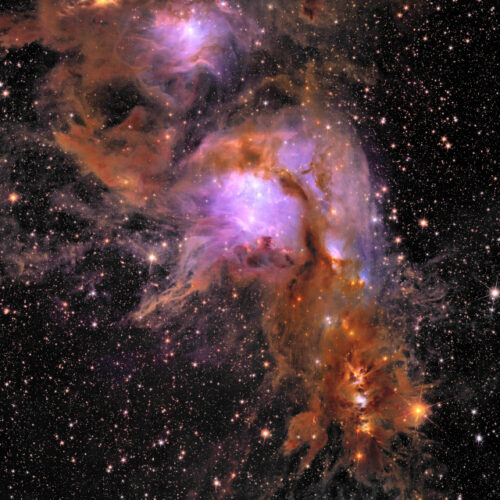
Messier 78 (ESA/Euclid/Euclid Consortium/NASA, image processing by J.-C. Cuillandre (CEA Paris-Saclay), G. Anselmi)

ESA and the Euclid Consortium have presented the first scientific results obtained thanks to the Euclid Space Telescope within the ERO (Early Release Observations) program. That’s a series of scientific articles partly written directly by the Consortium’s researchers and partly by different teams of researchers who worked within the ERO program. Some images illustrate the possibilities of this instrument but research into some of the major cosmological mysteries goes far beyond the aesthetics of photos.

The Crew Dragon Freedom spacecraft blasting off to begin the Ax-3 mission (Image courtesy Axiom Space)

A few hours ago, SpaceX’s Crew Dragon Freedom spacecraft was launched atop a Falcon 9 rocket from the Kennedy Space Center on the Axiom Mission 3, or simply Ax-3, mission. After about twelve minutes, it successfully separated from the rocket’s last stage. It will spend about 14 days in orbit, almost all of which will be docked at the International Space Station. It also serves commercial purposes in a collaboration between SpaceX, Axiom Space, and various companies and national space agencies to access the Station for the purpose of conducting tasks useful for the development of new technologies and for scientific research.

The Perseus galaxy cluster (Image ESA/Euclid/Euclid Consortium/NASA, image processing by J.-C. Cuillandre (CEA Paris-Saclay), G. Anselmi, CC BY-SA 3.0 IGO)

ESA has presented the first official images captured by its Euclid space telescope. After some delays due to problems with the fine guidance sensor, it was possible to calibrate Euclid’s instruments and obtain the extraordinary precision of observations necessary for its mission. The result is a resolution that allows a quantity of detail never seen before to be included in the images, be it galaxies, stars, or other objects, often discovered by Euclid. The presentation showed the results both with distant objects such as the Perseus galaxy cluster and with others close in astronomical terms such as the Horsehead Nebula.

The XRISM space telescope and the SLIM Moon lander blasting off atop an H-IIA rocket (Image courtesy JAXA)

A few hours ago, the Japanese XRISM space telescope and the SLIM Moon lander were launched from the Tanegashima space center atop an H-IIA rocket. After just over 14 minutes, XRISM separated from the rocket’s last stage and after about 48 minutes, SLIM did the same. XRISM will reach low Earth orbit, where it will position at an altitude of approximately 550 kilometers. SLIM started a much longer journey.

The Crew Dragon Endurance spacecraft approaching the International Space Station in its Crew-7 mission (Image NASA TV)

A little while ago, SpaceX’s Crew Dragon Endurance spacecraft docked with the Harmony module of the International Space Station completing the first part of its Crew-7 or SpaceX Crew-7 mission that began with its launch almost 30 hours earlier. After checking that the pressure gets properly balanced, the hatch will be opened to allow Jasmin Moghbeli, Andreas Mogensen, Satoshi Furukawa, and Konstantin Borisov to enter the Station and start their mission, which will last about six months.