ESA

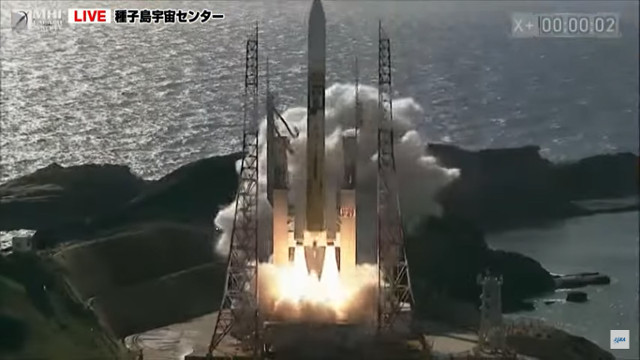
The XRISM space telescope and the SLIM Moon lander blasting off atop an H-IIA rocket (Image courtesy JAXA)

A few hours ago, the Japanese XRISM space telescope and the SLIM Moon lander were launched from the Tanegashima space center atop an H-IIA rocket. After just over 14 minutes, XRISM separated from the rocket’s last stage and after about 48 minutes, SLIM did the same. XRISM will reach low Earth orbit, where it will position at an altitude of approximately 550 kilometers. SLIM started a much longer journey.

The Crew Dragon Endurance spacecraft approaching the International Space Station in its Crew-7 mission (Image NASA TV)

A little while ago, SpaceX’s Crew Dragon Endurance spacecraft docked with the Harmony module of the International Space Station completing the first part of its Crew-7 or SpaceX Crew-7 mission that began with its launch almost 30 hours earlier. After checking that the pressure gets properly balanced, the hatch will be opened to allow Jasmin Moghbeli, Andreas Mogensen, Satoshi Furukawa, and Konstantin Borisov to enter the Station and start their mission, which will last about six months.

SpaceX's Crew Dragon Endurance spacecraft blasting off atop a Falcon 9 rocket in its Crew-7 mission (Image NASA TV)

A little while ago, SpaceX’s Crew Dragon Endurance spacecraft blasted off atop a Falcon 9 rocket from the Kennedy Space Center in its Crew-7 or SpaceX Crew-7 mission. After almost exactly twelve minutes, it successfully separated from the rocket’s last stage and went en route to carry out its mission. This is the 7th crewed mission of the Crew Dragon spacecraft within the normal rotation of the International Space Station crew. This is also the third mission for the Endurance. The launch takes place a day late because it took longer than expected to check the status of some valves of the life support system carried out after some of those of another Crew Dragon started corroding.

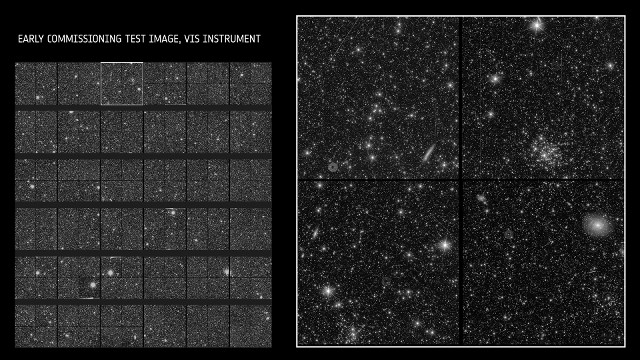
Early commissioning test image – VIS instrument full field of view and zoom in for detail

ESA has published the first test images captured by the Euclid Space Telescope. As soon as Euclid reached its destination, testing of both instruments, VIS and NISP, began and will continue for a couple of months to calibrate them until they reach optimal performance. They are necessary tasks to enable Euclid to conduct the scientific mission which consists of investigating the dark universe to try to solve some cosmological mysteries such as that of the acceleration of the universe expansion.

The Euclid Space Telescope blasting off atop a Falcon 9 rocket (Image courtesy SpaceX)

A little while ago, ESA’s Euclid Space Telescope was launched atop a SpaceX Falcon 9 rocket from Cape Canaveral. After just over 40 minutes, it successfully separated from the rocket’s last stage and entered its course that will take it towards the so-called L2 point, about 1.5 million kilometers from Earth, where its scientific mission will begin with an investigation of the dark universe.

The Euclid Space Telescope mission is focused on the cosmological mysteries connected to dark matter and dark energy. Cosmological research in recent decades indicates that the universe we see with the ordinary matter that forms galaxies constitutes only a small part of the cosmos. Astronomers and physicists are having difficulty investigating parts of the cosmos that we can neither see nor directly detect. It’s a problem that makes it difficult to test models that try to explain the effects that led to hypothesize the existence of dark matter and dark energy. For this reason, ESA developed a scientific mission focused on these cosmological problems.