ESA

The JUICE space probe blasting off atop an Ariane 5 ECA rocket (Image courtesy Arianespace)

A little while ago, ESA’s JUICE (JUpiter ICy moons Explorer) space probe was launched atop an Ariane 5 ECA rocket from the Kourou base in French Guiana. After about 27 minutes, it successfully separated from the rocket’s last stage and began the long journey that will take it to Jupiter orbit, where it will conduct its scientific mission, focused on the largest planet in the solar system’s so-called icy moons: Ganymede, Europa, and Callisto.

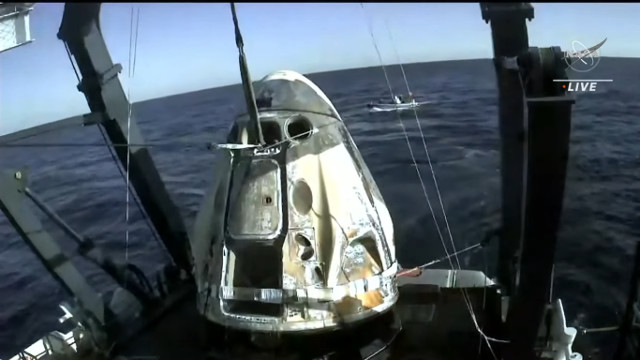
The Crew Dragon Freedom spacecraft on the ship Megan (Image NASA TV)

A few hours ago, SpaceX’s Crew Dragon Freedom spacecraft concluded its Crew-4, or SpaceX Crew-4, mission on behalf of NASA by splashing down without problems. On board were astronauts Jessica Watkins, Bob Hines, Kjell Lindgren, and Samantha Cristoforetti, who had reached the International Space Station on April 27 and were part of Expedition 67 and 68. The four of them completed SpaceX’s fourth regular crewed mission in the Atlantic Ocean off the coast of Jacksonville, Florida. The Crew Dragon departed the Station about six hours earlier.

The Sun as seen by the Solar Orbiter space probe on March 25, 2022

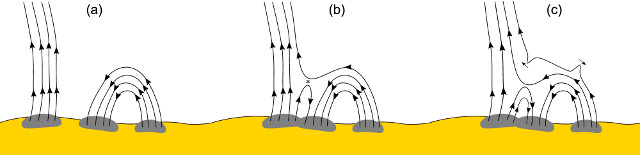
An article published in “The Astrophysical Journal Letters” offers a solution to the mystery of the local magnetic field inversion in the solar atmosphere, called switchback in jargon, observed in recent decades. A team of researchers with an important participation from the Italian National Institute of Astrophysics used detection conducted with the Solar Orbiter space probe’s METIS instrument to test the theories produced over the years.

The Vega-C rocket blasting off for its maiden mission (Image courtesy ESA)

A little while ago, the new European Vega-C rocket, the evolution of the Vega rocket that was in service for almost exactly 10 years, blasted off from the European launch base in French Guayana. After about 85 minutes, various satellites started being put into orbit including LARES-2 for the Italian Space Agency and some nanosatellites.

The main payload for the first flight of the Vega-C carrier rocket, referred to as VV21, is the LARES-2 (Laser Relativity Satellite 2) satellite of ASI (Italian Space Agency). It’s an improved successor to the LARES satellite launched on February 13, 2012, during the original Vega rocket’s qualification flight. The aim remains to test some aspects of the theory of relativity.

The secondary payload consists of CubeSat-class nanosatellites, which are now very common and consequently normal cargoes for a launch vehicle like Vega-C. These are the Italian AstroBio CubeSat and Greencube, the Slovenian Trisat-R, and the French MTCube-2 and Celesta.

Webb's First Deep Field (Image NASA, ESA, CSA, and STScI)

NASA has released the first official images captured by the James Webb Space Telescope. The presentation was made in collaboration with ESA and CSA (Canadian Space Agency), the other space agencies that work together with NASA on the project and its management. Yesterday, when it was afternoon at the White House, US President Joe Biden personally presented the top image, Webb’s First Deep Field image that includes the SMACS 0723 galaxy cluster as a preview, a proof of the importance of this space telescope.