ESA

Arcadia Planitia on Mars

ESA has published a photo of the Arcadia Planitia region on Mars captured by its Mars Express space probe’s High Resolution Stereo Camera (HRSC). This is an interesting region from a geological point of view because it’s northwest of the large volcanoes of Tharsis, the largest in the entire solar system, and traces of ancient lava flows are still visible. It could be important for the exploration of the red planet if confirmation of the presence of frozen water right under the surface were to arrive.

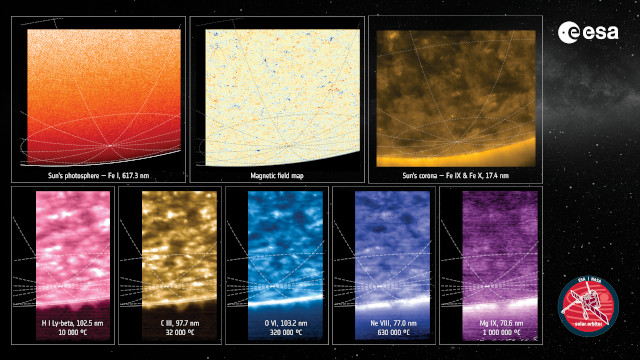
The Sun observed across eight different wavelengths by the Solar Orbiter space probe

ESA has released the first information, including the first images, of the Sun’s South Pole, captured between March 16 and 17, 2025, by the Solar Orbiter space probe, a mission operated in collaboration with NASA. Three of the scientific instruments on board made it possible to observe that area in different electromagnetic bands: Polarimetric and Helioseismic Imager (PHI), Extreme Ultraviolet Imager (EUI), and Spectral Imaging of the Coronal Environment (SPICE). The Sun’s poles aren’t visible from Earth, and Solar Orbiter is observing them as never before. The first observations have already revealed some surprises.

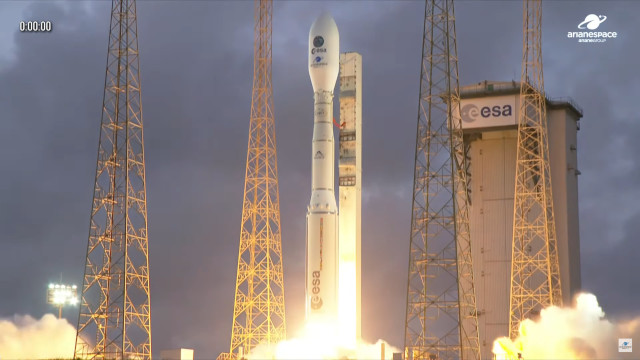
The Biomass satellite blasting off atop a Vega-C rocket (Image courtesy Arianespace)

A little while ago, the Biomass satellite was launched atop a Vega-C rocket from the Kourou base in French Guiana. After about 58 minutes, it successfully separated from the rocket’s last stage and set off on a course that will take it to its Sun-synchronous orbit at an altitude of 666 kilometres, where it will study the biomass of forests around the world. This work will help us better understand the global carbon cycle and forest ecosystems.

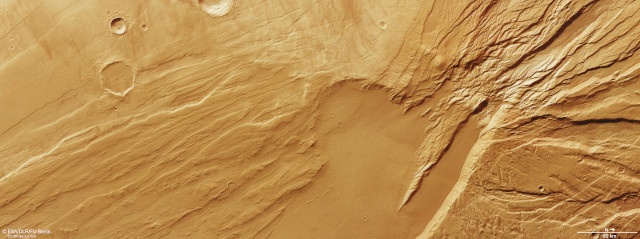
The area around the Acheron Fossae region on Mars

ESA has released images of the Acheron Fossae region on Mars captured by its Mars Express space probe’s High Resolution Stereo Camera (HRSC). The peculiarity of these images is that they show the two faces of Mars, meaning that they show how the red planet is basically divided into two parts with very different geological characteristics. About half of Mars is composed of an ancient terrain marked by craters and other signs of age and activity, while the other half is much smoother, with a surface probably reshaped by lava from volcanoes that are no longer active.

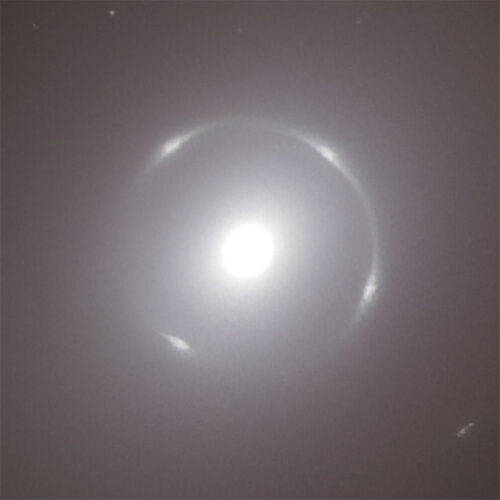
The Einstein ring around galaxy NGC 6505 (Image ESA/Euclid/Euclid Consortium/NASA, image processing by J.-C. Cuillandre, G. Anselmi, T. Li / CC BY-SA 3.0 IGO)

An article published in the journal “Astronomy & Astrophysics” reports the identification of a practically perfect so-called Einstein ring around the galaxy NGC 6505. A team of researchers Conor led by O’Riordan of the Max Planck Institute for Astrophysics in Munich, Germany, examined observations conducted with the Euclid space telescope to study the image of a much more distant galaxy distorted by the gravitational lens created by NGC 6505. This effect allows to study NGC 6505 as well because its mass creates that gravitational lens, so its effects allow to analyze it.