ESO

Artist's concept of the exoplanet HR 8799 e (Image ESO/L. Calçada)

An article published in the journal “Astronomy and Astrophysics” reports the first direct observation of an exoplanet using the technique of optical interferometry. The GRAVITY collaboration, so called because the researchers who belong to it manage the work of the instrument with the same name installed on ESO’s Very Large Telescope Interferometer (VLTI), observed the exoplanet HR 8799 e, a super-Jupiter that has a atmosphere containing clouds rich in iron and silicates that swirl around in a storm that crosses the entire planet.

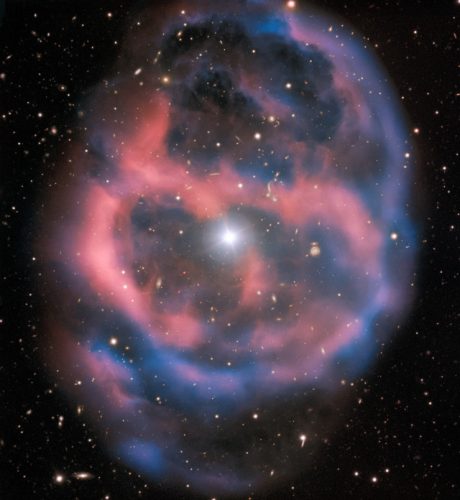
The planetary nebula ESO 577-24 seen in all its beauty by the Very Large Telescope

ESO has published a new image of the planetary nebula ESO 577-24 captured by its Very Large Telescope (VLT) in Chile thanks to its FORS2 instrument, which for almost twenty years has been capturing some of the best astronomical images obtained by the VLT. ESO 577-24 represents the final phase of the life of the star at its center, cataloged as Abell 36, in astronomical terms an instant of agony since its duration is estimated around 10,000 Earth years.

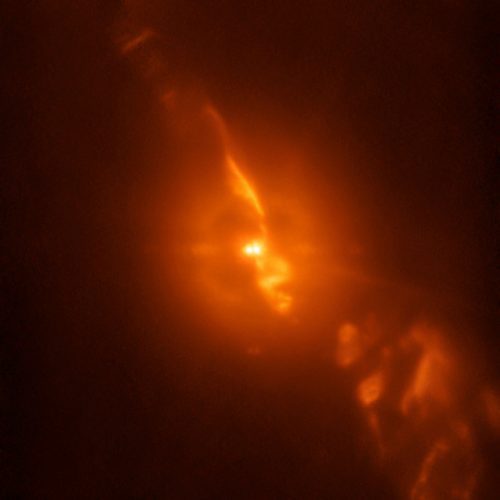
R Aquarii (Image ESO/Schmid et al.)

An article published in the journal “Astronomy & Astrophysics” describes a new observation of the R Aquarii binary system, consisting of a red giant of the type called Mira variable and a white dwarf. A team of researchers used that pair of stars as a target for a test of a new subsystem of the SPHERE instrument mounted on ESO’s VLT obtaining the clearest image captured so far of the turbulence existing in the system due to the fact that the white dwarf is stealing gas from its companion, worsening its agony.

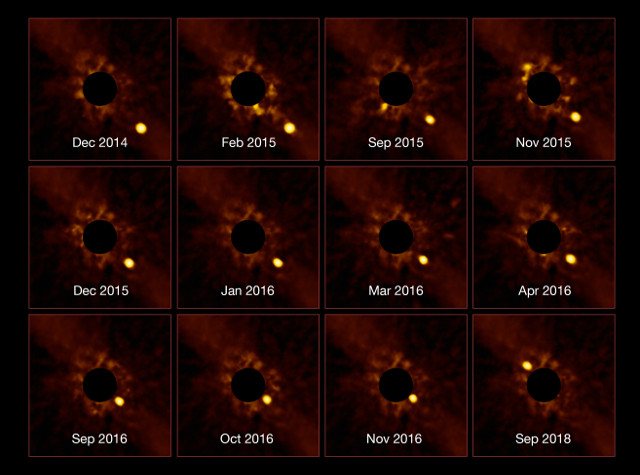
Beta Pictoris b (Image ESO/Lagrange/SPHERE consortium)

ESO has published a time-laps composition of images showing the exoplanet Beta Pictoris b while orbiting its star. It was discovered in 2008 using the NACO instrument mounted on the VLT in Chile and the team led by Dr. Anne-Marie Lagrange who discovered it kept on studying it some years later using the SPHERE instrument, which in the meantime was also mounted on the VLT. The researchers lost sight of it when it approached its star’s halo too closely to be resolved by any current instrument but got visible again in September 2018.

Simulation of materials near Sagittarius A* (Image ESO/Gravity Consortium/L. Calçada)

An article published in the journal “Astronomy & Astrophysics” describes the detection of very hot gas clouds that orbit the supermassive black hole at the center of the Milky Way, called Sagittarius A* or simply SgrA*. A team of researchers used the GRAVITY instrument installed on ESO’s VLT to observe infrared light flares coming from the gas and dust accretion disk that orbits SgrA* at very high speed. These are the most accurate observations of materials so close to a black hole’s event horizon.