
ESO

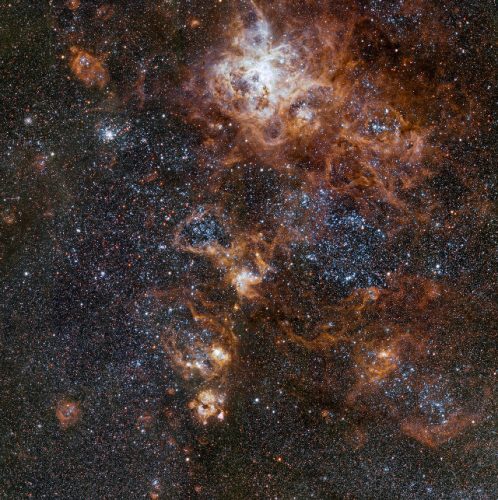
The Tarantula Nebula and its A crowded neighborhood for the Tarantula Nebula (Image ESO)

An image published by ESO shows the Tarantula Nebula along with the neighboring areas in their details. A team of astronomers used the VLT Survey Telescope (VST) at ESO’s Paranal Observatory, in Chile, to capture unseen details of star clusters, bright gas clouds and supernova remnants scattered around. It’s the sharpest image ever obtained of that region of the Large Magellanic Cloud, one of the Milky Way’s satellite dwarf galaxies.

The center of the galaxy NGC 5643 (Image ESO/A. Alonso-Herrero et al.; ALMA (ESO/NAOJ/NRAO))

An image published by ESO and ALMA collaboration shows the center of the galaxy NGC 5643 obtained by combining observations made with the ALMA radio telescope with archive data of the MUSE instrument, mounted on ESO’s VLT. In this way it was possible to see beyond the clouds of dust and gas that obscure it even though it’s an active galactic nucleus with strong electromagnetic emissions generated by the activity of the supermassive black hole at the center of NGC 5643.

The SPT2349-56 proto-cluster (Image ESO/ALMA (ESO/NAOJ/NRAO)/Miller et al.)

Two articles, one published in the journal “Nature” and one in the journal “Astrophysical Journal”, describe the observations of the merger among various starburst galaxies, characterized by a remarkable production of stars. Two teams, led by Tim Miller of Dalhousie University in Canada and Yale University in the USA, and Iván Oteo of the Scottish University of Edinburgh used the ALMA and APEX radio telescopes to study these events which are very ancient as they happened about 1.5 billion years after the Big Bang.

Star systems observed by the SPHERE instrument (Image ESO/H. Avenhaus et al./E. Sissa et al./DARTT-S and SHINE collaborations)

Two articles, one published in the “Astrophysical Journal” and one in “Astronomy & Astrophysics”, describe two researches on a number of star systems. Two teams used the SPHERE instrument mounted on ESO’s VLT in one case to study dust and gas disks around a number of young stars in their formation stage and in the other case to study a pair of disks in a system with three stars.

The supernova remnants 1E 0102.2-7219

An article published in the journal “Nature Astronomy” describes the study of the supernova remnants identified as 1E 0102.2-7219 in the Small Magellanic Cloud. A team of researchers led by Frédéric Vogt used the MUSE instrument installed on ESO’s VLT to observe a large ring of gas in that system that is slowly expanding into the depths of several other gas filaments that are quickly moving away, leaving behind a neutron star in the center.