Galaxies

The M82 galaxy in Hubble's view on the left and the area of very intense star formation seen by Webb on the right

An article submitted for publication in “The Astrophysical Journal” reports a study of the exceptional rate of star formation in the M82 galaxy. A team of researchers led by Alberto Bolatto of the University of Maryland, College Park, used the James Webb Space Telescope to map powerful galactic winds that expel vast amounts of gas caused by star formation and supernova explosions.

The NIRCam instrument is the one used in particular to trace the origin of that activity back to dense star clusters in the galactic disk. This new study of M82 offers advances in understanding star formation and how this activity is affecting the galaxy.

Una porzione di cielo fotografata dallo strumento NIRCam del telescopio spaziale James Webb con la galassia GN-z11 nel riquadro

Two articles, one published in the journal “Nature” and one accepted for publication in the journal “Astronomy & Astrophysics”, report different aspects of a study of the galaxy GN-z11, one of the most distant known, which revealed the presence of the most distant and ancient black hole found so far. A team of researchers led by Roberto Maiolino of the University of Cambridge used the James Webb Space Telescope to examine GN-z11 finding traces of the activity of the supermassive black hole at its center. Those traces indicate that it’s devouring surrounding materials at a remarkable speed. Spectroscopic analyzes showed the presence of a clump of helium in the halo surrounding GN-z11 and no heavy elements, suggesting that first-generation stars may form in that halo.

The region of sky where quasar J0529-4351 is located. It was created from images forming part of the Digitized Sky Survey 2 while the inset shows the position of this quasar in the center in an image from the Dark Energy Survey.

An article published in the journal “Nature Astronomy” reports the identification of the brightest and most voracious quasar discovered so far, cataloged as J0529-4351. A team of researchers used various instruments to understand that it wasn’t a nearby star but a primordial quasar we see as it looked over 12 billion years ago.

The researchers estimated that the mass of the supermassive black hole that powers it is about 17 billion times the Sun’s, and it’s devouring materials around it at a very high rate, about the mass of the Sun every day. The study of this record-breaking primordial quasar can help reconstruct the history of the early universe and the processes that led to it becoming what it is today.

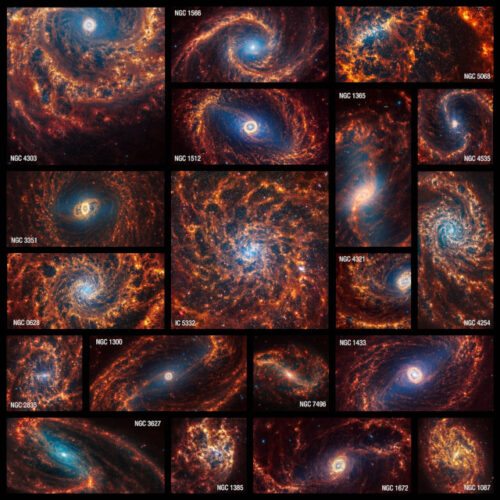
Mosaic of the 19 spiral galaxies studied by the PHANGS project

The images of 19 spiral galaxies captured by the James Webb Space Telescope have been released as part of the PHANGS (Physics at High Angular resolution in Nearby GalaxieS) project. These are galaxies up to 65 million light-years away that we see face-on, and this allows to better observe the stars inside them, an optimal situation for a project focused on star formation processes. Webb’s NIRCam (Near-Infrared Camera) and MIRI (Mid-Infrared Instrument) instruments were employed to cover the near and mid-infrared resulting in many new details.

LEDA 60847 (Image NASA/ESA/A. Barth (University of California - Irvine)/M. Koss (Eureka Scientific Inc.)/A. Robinson (Rochester Institute of Technology)/Processing: Gladys Kober (NASA/Catholic University of America))

An image captured by the Hubble Space Telescope shows LEDA 60847, a group of interacting galaxies. The largest galaxy has an active galactic nucleus (AGN) with a supermassive black hole surrounded by materials that are heated to the point of generating the electromagnetic emissions behind its luminosity. This galaxy is interacting with its neighbors and in a very long time, they will form a single larger galaxy.