Galaxies

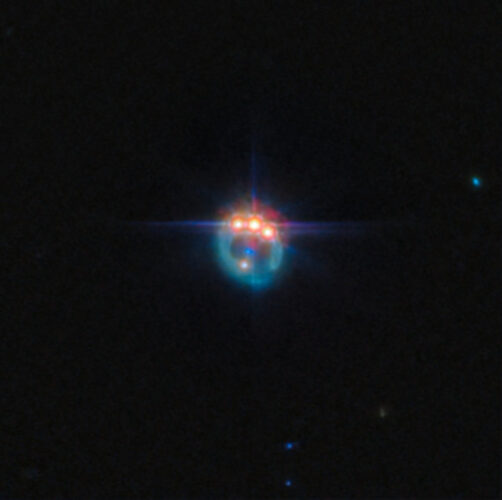
The quasar cataloged as RX J1131-1231, or simply RX J1131 (Image ESA/Webb, NASA & CSA, A. Nierenberg)

A new image captured by the James Webb Space Telescope depicts the quasar cataloged as RX J1131-1231, or simply RX J1131. About six billion light-years away from Earth, it’s visible in three different copies, recognizable in the upper part of the bright ring in the center of the image, due to a gravitational lensing effect generated by a galaxy between it and Earth. In particular, MIRI (Mid-Infrared Instrument) was used to observe RX J1131 with different mid-infrared filters as part of an observation program that studies dark matter.

The pair of quasars photographed by the Hyper Suprime-Cam mounted on Subaru Telescope

An article published in the journal “The Astrophysical Journal Letters” reports the discovery of the most distant pair of merging quasars known. A team of researchers combined observations from the Subaru Telescope with the Gemini North Telescope to find traces of this pair of quasars that we see as they were about 900 million years after the Big Bang.
Studying this pair of quasars can offer new insights into the epoch of reionization, the period that began about 400 million years after the Big Bang and was crucial in the history of the universe. That’s the time when the neutral, light-blocking hydrogen was ionized, resulting in the universe becoming the bright place we know today. An article accepted for publication in a journal of the American Astronomical Society offers further analysis based on observations conducted with the ALMA radio telescope.

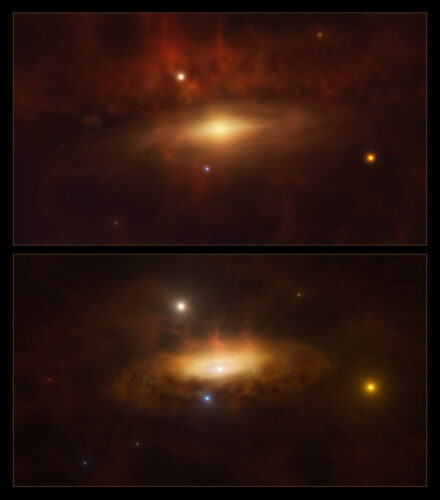
Artist's illustration of two phases of the formation of a disk of gas and dust around the supermassive black hole at the center of the galaxy SDSS1335+0728

An article accepted for publication in the journal “Astronomy & Astrophysics” reports the results of the observation of a new activity of the supermassive black hole at the center of the galaxy cataloged as SDSS J133519.91+072807.4 and called “simply” SDSS1335+0728. A team of researchers used observations conducted with various instruments to observe an increase in this galaxy’s brightness. This already led to its inclusion among those with an active galactic nucleus at the end of 2019.

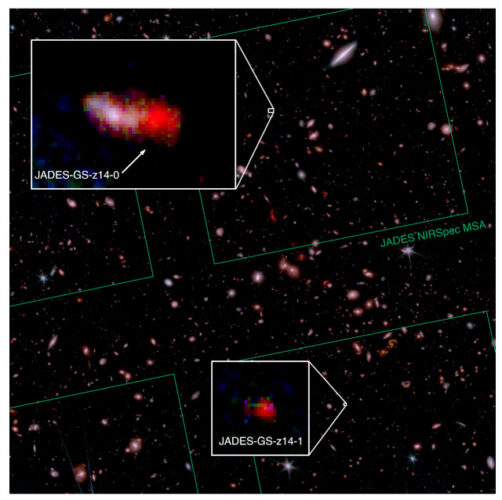
The JADES-Gs-z14-0 and JADES-Gs-z14-1 galaxies as seen by the James Webb Space Telescope, also zoomed in the insets

An article still in its peer-reviewed phase available in preview on the ArXiv server reports the identification of the primordial galaxies JADES-GS-z14-0 and JADES-GS-z14-1, which might be the most distant galaxies discovered so far. A team of researchers used observations conducted with the James Webb Space Telescope as part of the JWST Advanced Deep Extragalactic Survey (JADES) program to identify hundreds of candidate galaxies dating back to the first 650 million years of universe life. If the estimates made are confirmed, we see JADES-GS-z14-0 as it was about 290 million years after the Big Bang and therefore it would be the oldest known.

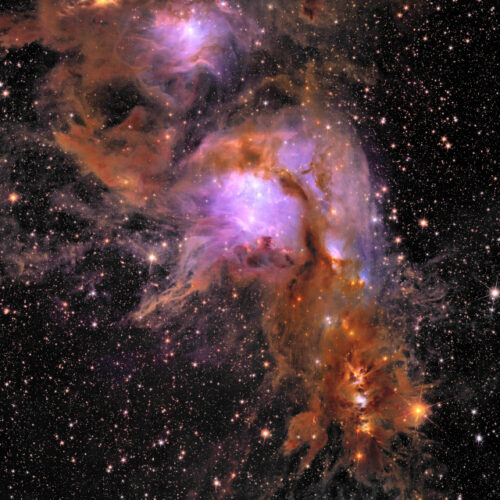
Messier 78 (ESA/Euclid/Euclid Consortium/NASA, image processing by J.-C. Cuillandre (CEA Paris-Saclay), G. Anselmi)

ESA and the Euclid Consortium have presented the first scientific results obtained thanks to the Euclid Space Telescope within the ERO (Early Release Observations) program. That’s a series of scientific articles partly written directly by the Consortium’s researchers and partly by different teams of researchers who worked within the ERO program. Some images illustrate the possibilities of this instrument but research into some of the major cosmological mysteries goes far beyond the aesthetics of photos.