
Galaxies

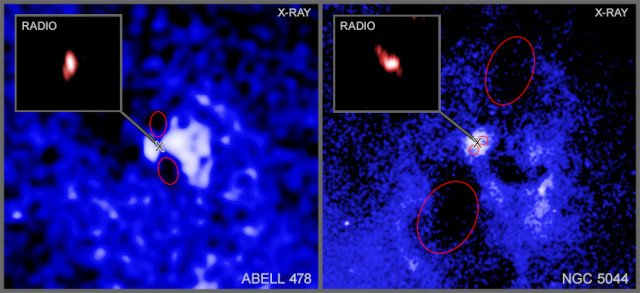
The galaxies Abell 478 and NGC 5044 seen in X-rays by the Chandra Observatory with data detected at radio waves by the VLBA (Very Large Baseline Array) radio telescope zoomed in the insets

An article published in “The Astrophysical Journal” reports a study of supermassive black holes that emit jets of energy that are aimed in different directions over time. A team of researchers led by Francesco Ubertosi of the University of Bologna, Italy, combined observations conducted with NASA’s Chandra X-ray Observatory and the VLBA radio telescope to examine 16 galaxies finding that about a third of their supermassive black holes emit jets that changed direction significantly within the last 10 million years. For this type of emission, they were compared to the Death Star.

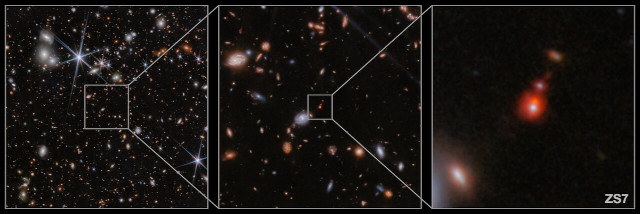
The position of the ZS7 system in past observations

An article published in the journal “Monthly Notices of the Royal Astronomical Society” reports evidence of the ongoing merger of two supermassive black holes in a pair of galaxies cataloged as ZS7 in the early universe. A team of researchers used observations conducted with the James Webb Space Telescope to obtain images of this event which we see as it was taking place when the universe was about 740 million years old and was therefore very young in astronomical terms. This is the most distant pair of merging black holes discovered so far and could offer insights valuable to understand how these extreme objects grew so quickly.

The quasar J0148+0600

An article published in “The Astrophysical Journal” reports the results of observations of primordial quasars that indicate that supermassive black holes form from “seeds” that are very massive and grow quickly. A team of researchers used observations conducted with the James Webb Space Telescope as part of the EIGER project to detect the faint light of the stars surrounding three of those quasars. This feat offers the possibility of obtaining much more information that allows to estimate the mass of galaxies and central supermassive black holes.

The estimates obtained for the three galaxies at the center of this study indicate that the primordial supermassive black holes were much more massive than today’s supermassive black holes compared to their host galaxies. According to the researchers’ reconstruction, primordial quasars powered by black holes engulfed materials at enormous speeds as they went from initial seeds to supermassive black holes.

A spectroscopic observation conducted with the James Webb Space Telescope's Near Infrared Spectrograph (NIRSpec) instrument of the galaxy Cosmos-11142 centered on the oxygen emission line doubly ionized

An article published in the journal “Nature” reports the observation of very strong winds coming from the supermassive black hole at the center of the galaxy Cosmos-11142 which inhibited star formation within it. A team of researchers led by Professor Sirio Belli of the University of Bologna, Italy, used the James Webb Space Telescope to detect the movement of cold neutral gas pushed at such a speed that it swept away the gas in the galaxy and thus prevented the formation of new stars. This is the first evidence of how a supermassive black hole can have that effect on a galaxy.

The M82 galaxy in Hubble's view on the left and the area of very intense star formation seen by Webb on the right

An article submitted for publication in “The Astrophysical Journal” reports a study of the exceptional rate of star formation in the M82 galaxy. A team of researchers led by Alberto Bolatto of the University of Maryland, College Park, used the James Webb Space Telescope to map powerful galactic winds that expel vast amounts of gas caused by star formation and supernova explosions.

The NIRCam instrument is the one used in particular to trace the origin of that activity back to dense star clusters in the galactic disk. This new study of M82 offers advances in understanding star formation and how this activity is affecting the galaxy.