Galaxies

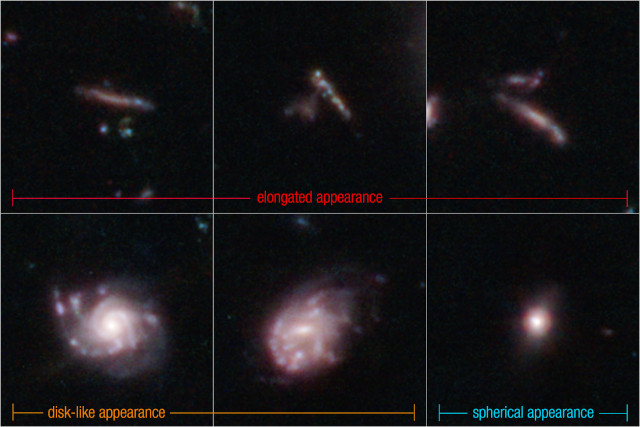
Some examples of the galaxies observed during the Cosmic Evolution Early Release Science (CEERS) survey

An article in publication in “The Astrophysical Journal” reports the results of observations of early galaxies that show strange shapes, decidedly different from the ones we’re used to and compared to bananas and even breadsticks. A team of researchers led by Viraj Pandya of Columbia University used observations conducted with the James Webb Space Telescope as part of the CEERS survey from which they obtained images of galaxies dating back to a period between 600 million and 6 billion years after the Big Bang.

The central area of the Milky Way as seen by the Subaru telescope. Several stars are visible in an area about 0.4 light-years across. The star S0-6 is circled in blue while the area where the supermassive black hole Sagittarius A* is located is circled in green.

An article published in the journal “Proceedings of the Japan Academy, Series B, Physical and Biological Sciences” reports a study on the star cataloged as S0-6 which indicates that it formed in another galaxy and only over time reached the center of the Milky Way. Since 2014, a team of researchers led by Shogo Nishiyama of Miyagi University of Education in Japan has been studying various stars that now orbit Sagittarius A*, or simply Sgr A*, the supermassive black hole at the center of the Milky Way.

The AzTECC71 galaxy (Image J. McKinney/M. Franco/C. Casey/The University of Texas at Austin)

An article published in “The Astrophysical Journal” reports a study on AzTECC71, what appears to be a dusty primordial galaxy in which remarkable star formation is taking place. A team of researchers from the COSMOS-Web collaboration led by Jed McKinney of the University of Texas at Austin observed what appeared to be a ghost galaxy with the James Webb Space Telescope. The peculiarity of this study is that AzTECC71 was detected by some ground-based telescopes but didn’t appear to the Hubble Space Telescope. This may be a much more common case than previously thought that requires some sort of ghostbuster to find.

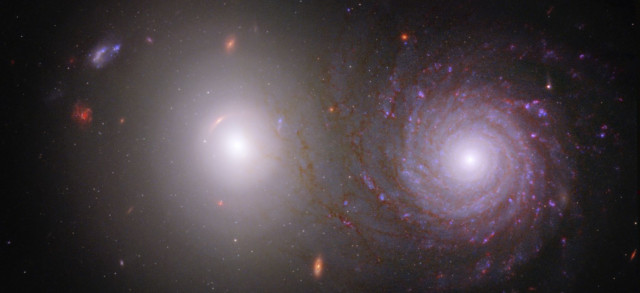
An elliptical galaxy on the left and a spiral galaxy on the right

An article published in the journal “Nature Astronomy” provides an explanation for the scarcity of spiral galaxies in the so-called Supergalactic Plane. A team of researchers used results obtained from the SIBELIUS supercomputer simulation to offer an explanation based on galaxy mergers. The analysis of the results indicates that in galaxy clusters present on the Supergalactic Plane, interactions and mergers are common with the result that spiral galaxies merge to become elliptical galaxies. Far from the Supergalactic Plane, galaxies are more isolated and therefore less likely to merge.

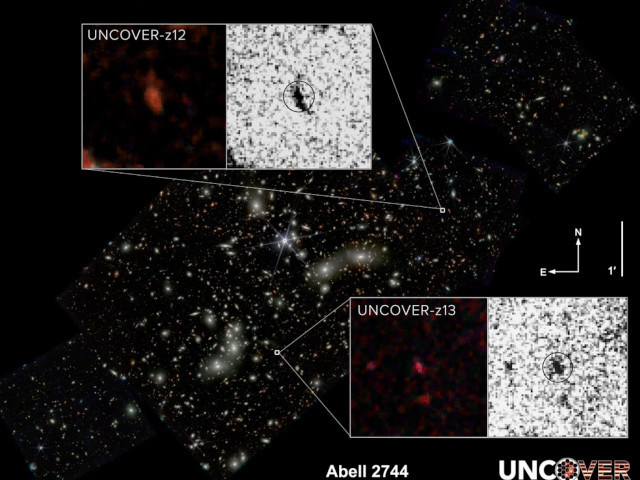
The galaxy cluster Abell 2744 and in the insets the galaxies UNCOVER z-13 and UNCOVER z-12.

An article published in “The Astrophysical Journal Letters” reports confirmations of two primordial galaxies studied within the UNCOVER survey. A team of researchers examined spectroscopic detections obtained by the James Webb Space Telescope’s NIRSpec instrument to obtain good estimates of the distance to the galaxies UNCOVER z-13 and UNCOVER z-12. These are follow-up observations that exploited the gravitational lens generated by the Abell 2744 galaxy cluster. According to the estimates, UNCOVER z-13 is approximately 13.51 billion light-years away while UNCOVER z-12 is approximately 13.48 billion light-years away.