Galaxies

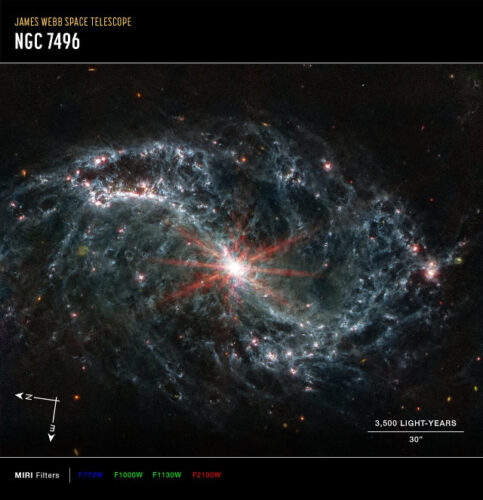
The galaxy NGC 7496 as seen by the James Webb Space Telescope (Image NASA, ESA, CSA, and J. Lee (NOIRLab), A. Pagan (STScI))

A special issue of “The Astrophysical Journal Letters” contains a series of articles reporting the first results of the PHANGS–JWST survey. More than one hundred researchers from the Physics at High Angular resolution in Nearby Galaxies (PHANGS) Collaboration used the James Webb Space Telescope to examine the galaxies M74, NGC 7496, IC 5332, NGC 1365, and NGC 1433. In particular, the Mid-Infrared Instrument (MIRI) made it possible to observe structures within those galaxies in previously unseen detail. The information gathered is valuable for reconstructing star formation processes and the influence they have on the gas surrounding protostars and newborn stars.

The trio SDSSCGB 10189 (Image ESA/Hubble & NASA, M. Sun)

An image captured by the Hubble Space Telescope shows a trio of interacting galaxies. Cataloged as SDSSCGB 10189, the trio is a rare case of three massive, star-forming galaxies less than 50,000 light-years apart. At a galactic level, that’s a very short distance, and that’s why their shape is already distorting.

Galaxy mergers are an important topic of astronomical research and in this case, SDSSCGB 10189 is also an object of study for research on the origins of the so-called Brightest Cluster Galaxies (BCGs), the brightest within their clusters and also the most massive.

The results of some reconstructions of J1135's shape obtained starting from the detections conducted with the ALMA radio telescope in different electromagnetic frequencies

An article published in “The Astrophysical Journal” reports the characterization of the galaxy HATLASJ113526.2-01460, or simply J1135, which we see as it was about two billion years after the Big Bang. So far, the problem was actually being able to resolve their characteristics and now a team led by Professor Andrea Lapi used observations conducted with the ALMA radio telescope to obtain this result. ALMA’s power and sensitivity made it possible to detect even the very weak radio and submillimeter emissions, which might be the only ones that reach us from J1135 due to the considerable presence of interstellar dust within it. These observations help to better understand the formation and evolution of galaxies in the young universe.

The galaxy LEDA 2046648 together with many stars and especially galaxies seen by the James Webb Space Telescope

An image captured by the James Webb Space Telescope portrays the galaxy LEDA 2046648 immersed in a vast group of other more or less distant galaxies. Many spiral galaxies are recognizable and this is to be expected as they’re the most common type. The NIRCam instrument captured many details of LEDA 2046648 despite being over a billion light-years away from Earth, but Webb’s performance is no longer astonishing. The observation that generated this image is among those used to calibrate the NIRISS instrument, which was out of service for a couple of weeks in the second half of January 2023 but has now resumed transmitting the collected data normally.

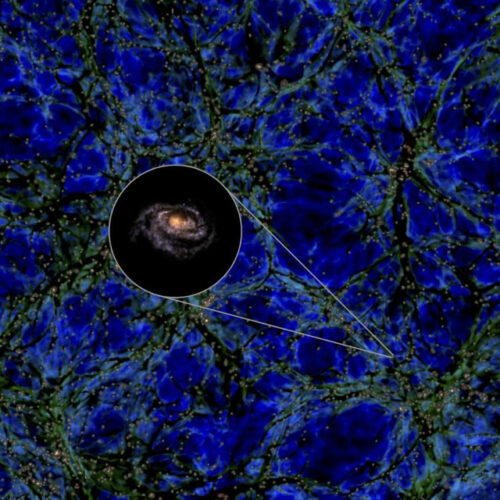
An image of the Milky Way superimposed on that of galaxies (represented as yellow dots) simulated in the IllustrisTNG project immersed in dark matter (in green and blue)

An article published in the journal “Monthly Notices of the Royal Astronomical Society” reports the results of a study that indicates that the Milky Way is abnormally massive in relation to the so-called Local Sheet, the group of galaxies that surround it. A team of researchers used simulations conducted within the IllustrisTNG project and discovered that a galaxy in the same situation as the Milky Way should be much smaller than the cosmic wall that surrounds it. The simulations indicate that there’s one exception for every million galaxies in IllustrisTNG under the same conditions. This must be kept in mind in studies of galactic environments.