Galaxies

The map of the polarized microwave emission measured by the QUIJOTE experiment

Six articles published in the journal “Monthly Notices of the Royal Astronomical Society” report various aspects of the most accurate mapping of the polarization of the Milky Way’s microwave emissions. This provides a map of the galactic magnetic field thanks to the QUIJOTE (Q-U-I JOint TEnerife) experiment. The QUIJOTE Collaboration presented what is only the initial set of scientific papers in a survey that complements the ones obtained from other missions such as the one from the Planck Surveyor satellite. These results are useful to obtain new information on the structure of the Milky Way’s magnetic field and to understand the energetic processes that occurred soon after the birth of the universe.

A mosaic of 690 frames obtained with Webb's Near Infrared Camera (NIRCam) instrument which constitutes one of the first images of the CEERS survey and shows in the insets some examples of primordial galaxies

An article accepted for publication in “The Astrophysical Journal” reports the results of a study of the structure and morphology of galaxies that existed in the first three billion years of life of the universe. A team of researchers used observations conducted with the James Webb Space Telescope as part of the CEERS survey to obtain enough detail to understand what primordial galaxies were like. The conclusion is a confirmation of previous research regarding the remarkable variety of shapes and structures and turned out even superior thanks to Webb. In many of them, the structures are already quite evolved, as in closer and younger galaxies.

The six barred spiral galaxies identified by the James Webb Space Telescope

An article accepted for publication in “The Astrophysical Journal Letters” reports the discovery of six barred spiral galaxies that are between 8.4 and 11 billion years old. A team of researchers used the James Webb Space Telescope within the CEERS survey to observe enough details of these galaxies to identify the two extensions of stars that start from their center and reach the outer disk in a structure that resembles a bar. It’s a crucial structure for the evolution of these galaxies, as it favors the growth of the supermassive black holes at their center and star formation in their central regions.

The galaxy clusters MOO J1014+0038 (left panel) and SPT-CL J2106-5844 (right panel) as seen by the Hubble Space Telescope's Wide Field Camera 3 instrument at infrareds

An article published in the journal “Nature” reports the results of a study on the so-called intracluster light that permeates galaxy clusters. Hyungjin Joo and M. James JeeĀ of Yonsei University in Seoul, South Korea, used the Hubble Space Telescope to examine ten galaxy clusters and the glow within them. The surprising and therefore interesting discovery was that intracluster light is abundant even in the oldest clusters, a sign that the stars that emit it were ejected from their galaxies a long time ago. This suggests that this happened at the same time as the formation and growth of the clusters.

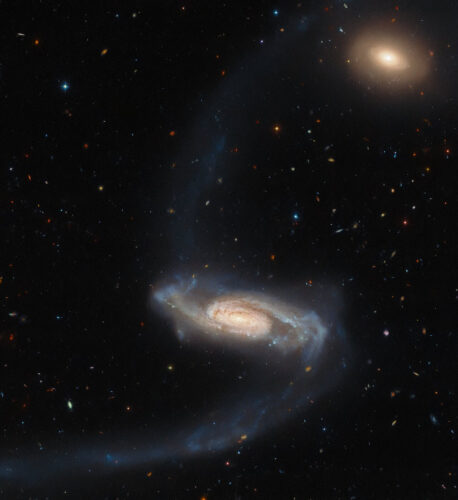
The galaxy ESO 415-19 (Image ESA/Hubble & NASA, J. Dalcanton, Dark Energy Survey/DOE/FNAL/DECam/CTIO/NOIRLab/NSF/AURA)

An image captured by the Hubble Space Telescope shows the galaxy ESO 415-19 and its long arms, making it a decidedly unusual spiral galaxy. It’s a spiral galaxy but was included in the Atlas of Peculiar Galaxies due to the extraordinary extension of its arms. So far, no other traces of the cosmic interaction that caused this anomaly in ESO 415-19 have been found but its peculiarity made it an interesting object of observation with Hubble and other instruments. For publication, photos taken with Hubble’s ACS instrument were combined with others captured with the DECam camera on the Victor M. Blanco telescope.