Galaxies

The galaxies RS13 and RS14 as they appeared in images captured by the Spitzer Space Telescope and as they appear in the image captured by Webb

An article published in “The Astrophysical Journal Letters” reports the identification of a population of rare red spiral galaxies in the SMACS J0723.3-7327 galaxy cluster. A team of researchers used observations conducted with the James Webb Space Telescope to find details of these galaxies which are estimated to date back to when the universe was about two to three billion years old.

The unprecedented detail captured by Webb helps to make progress in understanding the processes taking place in galaxies of various ages and understand why some appear red. Finding several very old ones suggests that over 10 billion years ago, red galaxies were more common.

Infographic of the primordial galaxies observed with the James Webb Space Telescope

Two articles that have yet to pass the peer-review phase report some results of observations of primordial galaxies conducted with the James Webb Space Telescope within the JWST Advanced Deep Extragalactic Survey (JADES) program which has precisely the aim of studying the oldest and faintest galaxies. A team of astronomers used Webb’s NIRCam and NIRSpec instruments to determine the distances of four galaxies we see as they were less than 400 million years after the Big Bang using a spectroscopic analysis of their light.

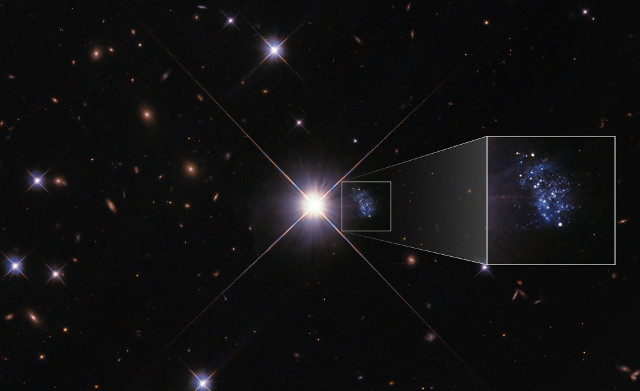
HIPASS J1131–31 / Peekaboo, magnified in the inset (Image Science: NASA, ESA, Igor Karachentsev (SAO RAS) image processing: Alyssa Pagan (STScI))

An article accepted for publication in the journal “Monthly Notices of the Royal Astronomical Society” reports a study of a dwarf galaxy cataloged as HIPASS J1131–31 that is relatively close but has the characteristics of a primordial galaxy. A team of researchers combined observations from various ground-based and space telescopes to confirm its nature, including the Hubble Space Telescope. They nicknamed it Peekaboo because it peeks out from behind a bright star that hid it for a long time and made it difficult to identify. It’s a very small galaxy but its primordial characteristics make it interesting for astronomers.

The SMACS-J0723.3-7327 galaxy cluster seen by the James Webb Space Telescope

An article published in “The Astrophysical Journal Letters” reports the results of the most complete analysis of the so-called intracluster light conducted so far. Mireia Montes and Ignacio Trujillo of the Instituto de Astrofísica de Canarias (IAC) used the James Webb Space Telescope to observe the SMACS-J0723.3-7327 galaxy cluster. In particular, they exploited the NIRCam instrument to detect intracluster light, which is extremely dim but useful to study galaxy clusters in ways other than visible light observations. These studies are also useful for understanding the distribution of dark matter.

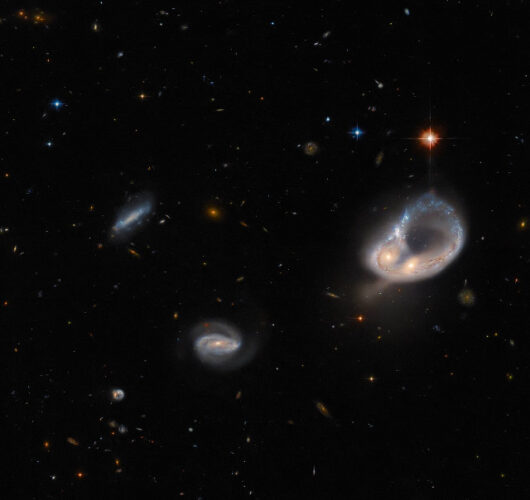
Arp-Madore 417-391, or simply AM 417-391, with other galaxies and stars

An image captured by the Hubble Space Telescope’s ACS instrument shows Arp-Madore 417-391, or simply AM 417-391, a pair of merging galaxies. It’s part of the Arp-Madore catalog, which collects particularly peculiar galaxies in the southern sky. It includes pairs of galaxies interacting at levels that go up to a merger just like AM 417-391.

The Advanced Camera for Surveys (ACS) instrument is optimized for hunting galaxies and galaxy clusters in the ancient universe. The AM 417-391 pair is “only” 670 million light-years away and makes an excellent object of study for astronomers interested in galaxy mergers.