Galaxies

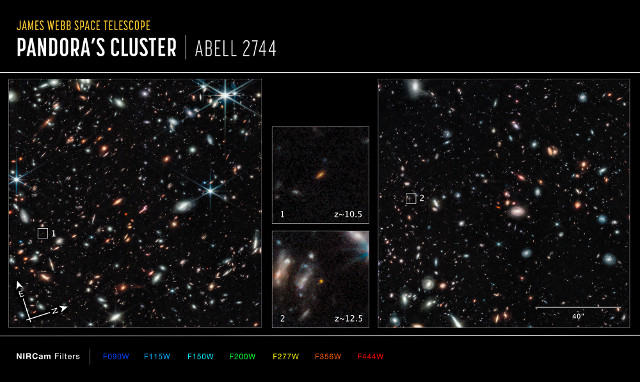
The galaxy cluster Abell 2744, nicknamed Pandora Cluster, with two boxes in the center showing the galaxies GLASS-z10 (1) and GLASS-z12 (2)

Two articles published in “The Astrophysical Journal Letters” report the results of the analysis of observations of the Abell 2744 galaxy cluster and the surrounding area with the James Webb Space Telescope. Two teams of researchers led respectively by Marco Castellano of the National Institute for Astrophysics in Rome, Italy, and by Rohan Naidu of the Harvard-Smithsonian Center for Astrophysics of MIT examined in particular two very distant galaxies. The galaxy called GLASS-z12 by the second team could be the oldest identified so far because according to estimates, it dates back to 350 million years after the Big Bang. The other galaxy, called GLASS-z10, is estimated to date back to 450 million years after the Big Bang.

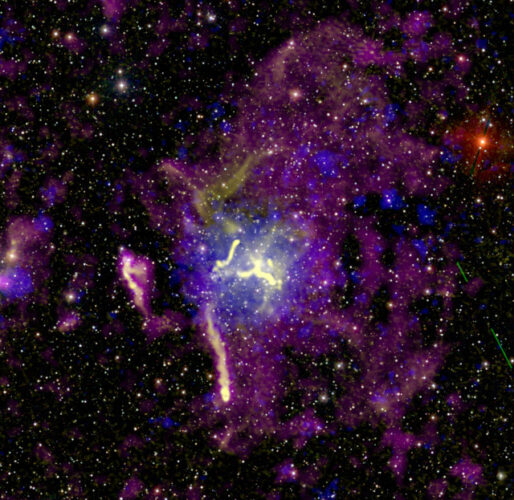
A composite view of the galaxy cluster Abell 2255

An article published in the journal “Science Advances” reports the results of a study of the galaxy cluster Abell 2255 which for the first time detected a radio glow on a scale so large that it surrounded the entire cluster. A team of researchers used the LoFar radio telescope for 18 nights over an area four times the size of the full moon to achieve such a detailed result. According to the researchers, the origin of that emission which is at least 16 million light-years wide is linked to the energy released during the cluster formation.

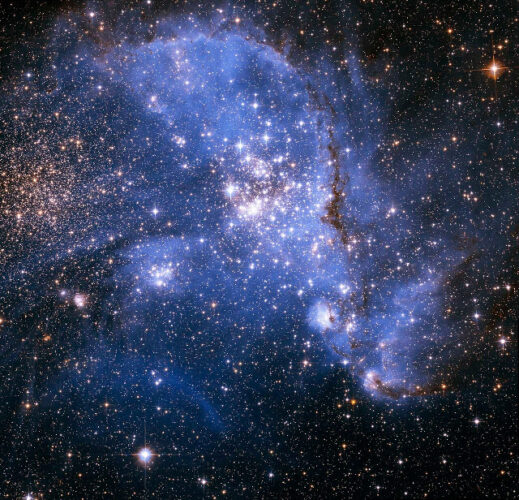
The cluster NGC 346 seen by Hubble (Image NASA, ESA, A. James (STScI))

Two articles published in “The Astrophysical Journal” report different aspects of a study on NGC 346, an open cluster of stars in the Small Magellanic Cloud, one of the satellite dwarf galaxies of the Milky Way. Two teams of researchers who share their respective leaders, Elena Sabbi of the Space Telescope Science Institute and Peter Zeidler of the AURA/STScI for ESA, used observations conducted with the Hubble Space Telescope and the VLT. They examined the spiraling motion of the cluster’s stars within it, a motion that appears to favor star formation.

Combined view of the galaxy SDSS J1448+1010 seen by ALMA and Hubble (Image ALMA (ESO/NAOJ/NRAO), J. Spilker et al (Texas A&M), S. Dagnello (NRAO/AUI/NSF))

An article published in “The Astrophysical Journal Letters” reports a study on the galaxy SDSS J1448+1010. A team of researchers used the ALMA radio telescope, the Hubble Space Telescope, and other instruments to examine it and found that no more stars are forming inside it. After analyzing the observations collected, they concluded that this is due to the fact that SDSS J1448+1010 is the result of a galaxy merger in which a large part of the hydrogen that forms the stars was ejected as a result of the gravitational effects suffered in the course of that event. In fact, the researchers discovered what was defined as a tidal tail formed by the ejected materials, which also include stars.

The galaxy M74 in a combined view at optical and infrared frequencies seen by the Hubble and Webb space telescopes, respectively

ESA has published images of the galaxy M74, nicknamed the Phantom Galaxy, captured by the Hubble and James Webb space telescopes with the addition of a combination between them. It’s a synergy that takes advantage of Hubble’s sensitivity to optical frequencies and Webb’s sensitivity to infrared frequencies. This allows to appreciate different details of a spiral galaxy that is practically visible face-on from the Earth and therefore an excellent object of study. Combining observations obtained with instruments that work in different electromagnetic bands is important Webb starts showing the great results it can offer in this type of study as well.