Galaxies

The galaxy M74 in a combined view at optical and infrared frequencies seen by the Hubble and Webb space telescopes, respectively

ESA has published images of the galaxy M74, nicknamed the Phantom Galaxy, captured by the Hubble and James Webb space telescopes with the addition of a combination between them. It’s a synergy that takes advantage of Hubble’s sensitivity to optical frequencies and Webb’s sensitivity to infrared frequencies. This allows to appreciate different details of a spiral galaxy that is practically visible face-on from the Earth and therefore an excellent object of study. Combining observations obtained with instruments that work in different electromagnetic bands is important Webb starts showing the great results it can offer in this type of study as well.

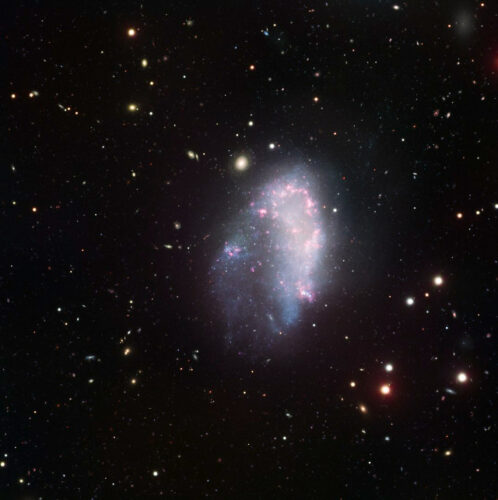
The dwarf galaxy NGC 1156 seen by Hubble (Image ESA/Hubble & NASA, R. B. Tully, R. Jansen, R. Windhorst)

An image captured by the Hubble Space Telescope portrays the dwarf galaxy NGC 1156, a truly unique object because it’s an irregular dwarf galaxy that has various characteristics that belong to different classes of galaxies. Typically, galaxies that are out of the ordinary are the result of interactions or mergers, which are sometimes still in progress and offer the possibility to see the shapes of the original galaxies. NGC 1156 is among other things an isolated galaxy, and that means that there are no other galaxies close enough to affect its shape with a much higher force of gravity.

NGC 1427A, one of the dwarf galaxies in the Fornax cluster that appear to be devoid of dark matter halos (Image ESO)

An article published in the journal “Monthly Notices of the Royal Astronomical Society” reports the results of a study of the distribution and morphology of the dwarf galaxies of the Fornax cluster which concludes that they are free of dark matter halos. A team of researchers coordinated by the German University of Bonn and the Scottish University of Saint Andrews examined those dwarf galaxies to see how perturbed they are by gravitational tides generated by nearby galaxies.

The Cartwheel galaxy seen by the James Webb Space Telescope (Image NASA, ESA, CSA, STScI)

An image captured by the James Webb Space Telescope shows the Cartwheel galaxy in greater detail than those obtained in the past with other telescopes. A combination of Webb’s NIRCam and MIR instruments allowed the identification of individual stars and star-forming regions while also offering new insights into the behavior of the supermassive black hole within this peculiar galaxy. This is a new help in the study of the changes taking place in what is most likely the consequence of a collision between two different galaxies with a transformation still taking place.

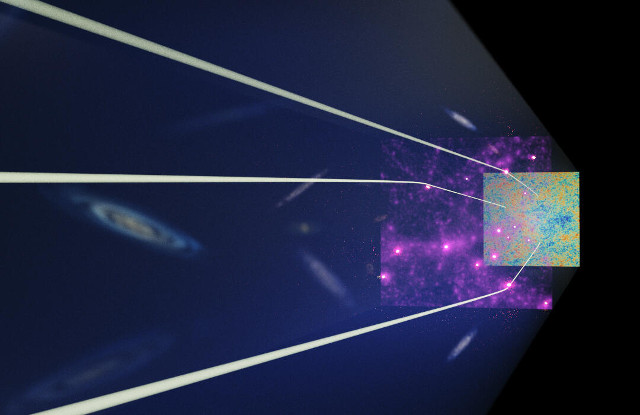
An artistic representation of the combination of the observations obtained in the HSC-SSP survey and the cosmic microwave background data collected by the Planck Surveyor space probe

An article published in the journal “Physical Review Letters” reports the results of an analysis of dark matter distribution around 1.5 million primordial galaxies. A team of researchers led by Hironao Miyatake of the Japanese University of Nagoya used observations conducted with the Subaru telescope and analyzed data collected by the Planck Surveyor space probe to detect distortion of the cosmic microwave background (CMB).

The results of this study show fluctuations in dark matter distribution in the early universe that led to inhomogeneity in the aggregation of ordinary matter that formed galaxies. That aggregation is lower than predicted by the Lambda-CDM model, the one that currently best describes the observations. The uncertainty lies in the difficulty of obtaining precise results in examining very distant galaxies.