Galaxies

Webb's First Deep Field (Image NASA, ESA, CSA, and STScI)

NASA has released the first official images captured by the James Webb Space Telescope. The presentation was made in collaboration with ESA and CSA (Canadian Space Agency), the other space agencies that work together with NASA on the project and its management. Yesterday, when it was afternoon at the White House, US President Joe Biden personally presented the top image, Webb’s First Deep Field image that includes the SMACS 0723 galaxy cluster as a preview, a proof of the importance of this space telescope.

The galaxy CGCG 396-2 (Image ESA/Hubble & NASA, W. Keel)

An image captured by the Hubble Space Telescope shows the galaxy CGCG 396-2, out of the ordinary thanks to its many arms. It’s a galaxy that has become an object of interest by the Galaxy Zoo project, one of the astronomical projects that involve the public, in this case, to classify galaxies observed by various telescopes. CGCG 396-2 was selected for follow-up observations with Hubble, whose ACS instrument made it possible to examine the arms that have an unusual configuration because there’s a galaxy merger taking place and consequently an unusual shape that is changing over time.

The ultra-faint dwarf galaxy Pegasus V

An article submitted for publication in the journal “Monthly Notices of the Royal Astronomical Society” reports the identification of an ultra-faint dwarf galaxy that was named Pegasus V near the Andromeda galaxy. A team of researchers conducted follow-up observations following the discovery made by an amateur astronomer and, using the GMOS instrument mounted on the Gemini North telescope in Hawaii, confirmed its existence. An interesting result of the observations is the very limited presence of elements heavier than hydrogen and helium, a discovery that led to the conclusion that it’s a kind of fossil of a primordial galaxy.

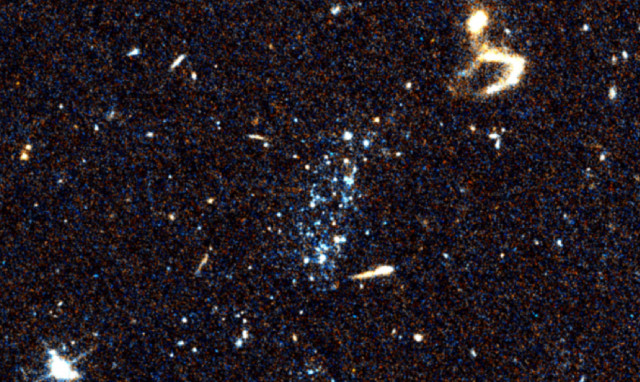
One of the star systems discovered in the Virgo cluster seen by the Hubble Space Telescope (Image courtesy Michael Jones)

An article submitted for publication to “The Astrophysical Journal” reports the discovery of star systems that are even smaller than a dwarf galaxy and are isolated from any normal galaxy. A team of researchers examined a catalog of gas clouds found in a previous survey looking for new galaxies and found small clusters that contain mostly young blue stars scattered irregularly within the Virgo galaxy cluster. These are cases similar to the one cataloged as SECCO 1, another system discovered in the Virgo cluster and reported in an article published in February 2018 in the journal “Monthly Notices of the Royal Astronomical Society”. The discovery of other such groups may help to understand their origin.

Infographic that shows the various subsets of data covering a total of approximately 1,800,000,000 stars observed by the Gaia space probe

ESA has released the third 3D map of the sky including the Milky Way and nearby galaxies obtained from the Gaia space probe, the most detailed of its kind ever produced. This catalog, built thanks to what was called Data Release 3 (DR3), greatly expands the previous maps released by ESA in recent years. Some uncertainties regarding data processing, also caused by the start of the pandemic, led ESA to publish an anticipation of DR3 called EDR3 (Early Data Release 3) on December 3, 2020.