Galaxies

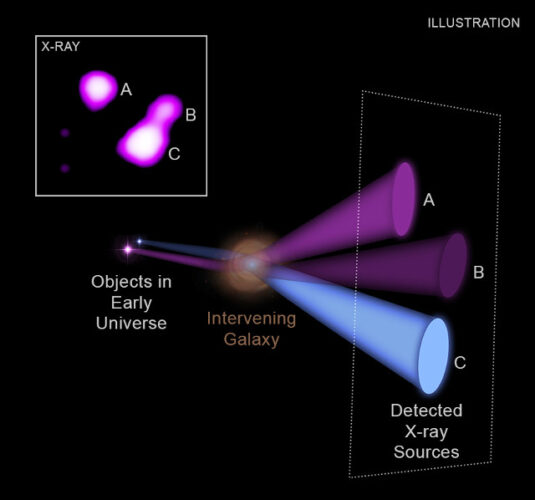
Illustration of MG B2016+112

An article published in “The Astrophysical Journal” reports a study on a double X-ray source in the early universe cataloged as MG B2016+112 which could be composed of two supermassive black holes whose image is distorted by a gravitational lens. Cristiana Spingola, Daniel Schwartz, and Anna Barnacka started from a survey obtained by NASA’s Chandra X-ray Observatory to examine the double object observed. This is an unprecedented situation because from the Earth we see it as it was when the universe was about two billion years old with the two components separated by only 650 light-years. At present, it cannot be ruled out that it’s a single supermassive black hole and one of its jets of materials whose image was strongly distorted by the gravitational lens.

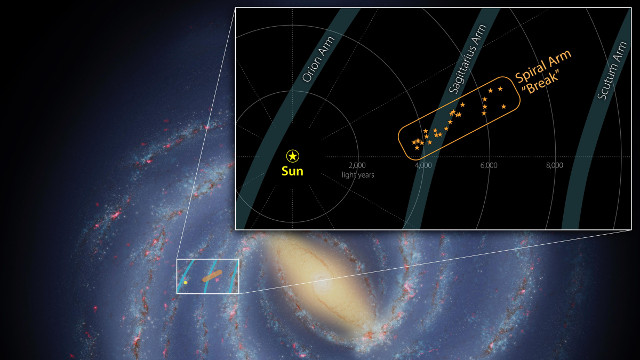
A reconstruction of the Milky Way, the Sagittarius Arm and its "splinter"

An article published in the journal “Astronomy & Astrophysics” reports the discovery of an anomalous structure in the Milky Way’s Sagittarius Arm. A team of researchers used observations made with NASA’s Spitzer Space Telescope and data collected by ESA’s Gaia space probe to locate a structure about 3,000 light-years long that has an orientation that’s very different from the rest of the Sagittarius Arm. Such structures have been identified in other galaxies but it’s the first time that one of them has been identified within the Milky Way. That’s not a surprise, as it’s difficult to study such large structures of the galaxy from the inside.

The galaxy Hercules A

A series of ten articles to be published in the journal “Astronomy & Astrophysics” reports the results of the activity of the LoFar network with its 70,000 antennas with unprecedented details of various galaxies at radio frequencies. A team of astronomers has published these results consisting of astronomical images obtained by making the most of the LoFar network’s capabilities. This made it possible to obtain images twenty times sharper than the previous ones generated by LoFar.

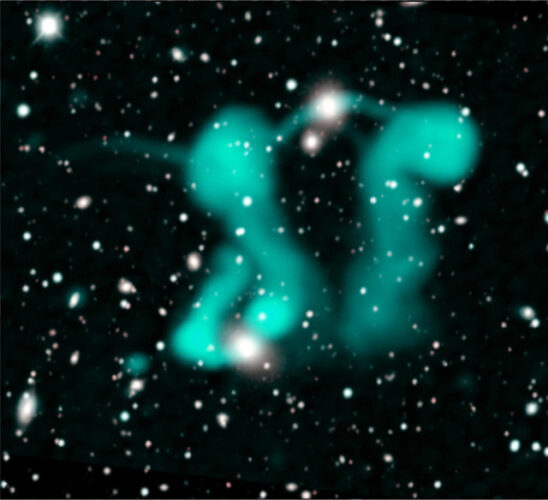
The dancing ghosts seen by ASKAP

An article accepted for publication in the journal “Publications of the Astronomical Society of Australia” reports the first results of the EMU (Evolutionary Map of the Universe) survey, which allowed to discover several objects and phenomena. One of those phenomena is made by strange clouds of electrons surrounding two galaxies about a billion light-years from Earth. This survey was conducted using the ASKAP radio telescope and led to the cataloging of about 220,000 sources including the electron clouds that were compared to dancing ghosts due to their curious shape.

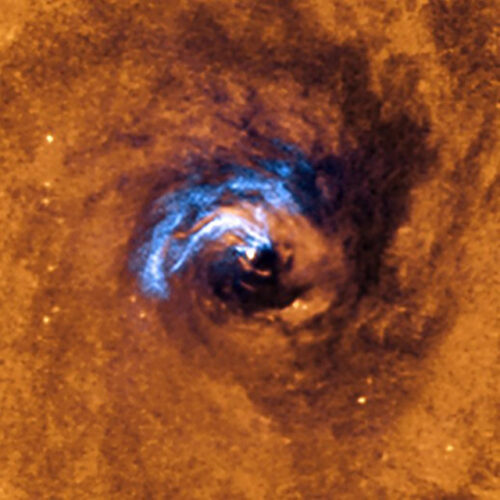
The process that was called nuclear feeding of the galaxy NGC 1566's supermassive black hole

An article published in the journal “Monthly Notices of the Royal Astronomical Society” reports a study on the feeding process of the supermassive black hole at the center of the galaxy NGC 1566. A team of researchers led by Almudena Prieto of the Instituto de Astrofísica de Canarias (IAC) used observations conducted with the Hubble Space Telescope, the VLT, and the ALMA radio telescope in Chile to be able to visualize filaments of interstellar dust that separate and subsequently head towards the supermassive black hole, approaching it in a spiral trajectory that eventually leads them to be swallowed. Those filaments could obscure the center of many galaxies with active galactic nuclei.