Galaxies

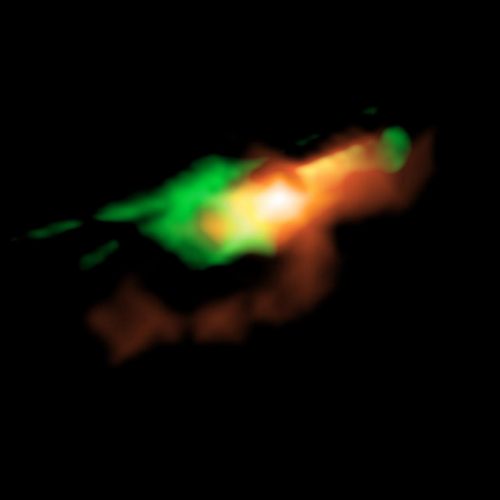
The quasar MG J0414+0534

An article published in “The Astrophysical Journal Letters” reports the observation of jets of energetic particles coming from a supermassive black hole interacting with clouds of gas around them in the quasar MG J0414+0534, about 11 billion light years away. A team of researchers used the ALMA radio telescope to observe that quasar, but its details were detected thanks to a gravitational lensing effect generated by a galaxy between the quasar and the Earth. The interaction between jets and clouds suggests that the quasar’s radio activity is at an early stage and therefore useful to better understand the early stages of evolution of the galaxies that host a quasar in the early universe.

Eros Vanzella indicates the Lyman-Alpha emission region measured with the MUSE instrument (Photo courtesy Eros Vanzella / INAF. All rights reserved)

An article published in the journal “Monthly Notices of the Royal Astronomical Society” reports the discovery of primordial stars that could belong to the so-called Population III, the first generation of stars in the universe. A team of astrophysicists led by Eros Vanzella and Massimo Meneghetti of the Italian National Institute of Astrophysics, Bologna, used data collected with the MUSE instrument mounted on ESO’s VLT and a powerful gravitational lens generated by the galaxy cluster MACS J0416.1-2403, or simply MACS J0416, to obtain magnified images of stars that seem free of metals and composed only of hydrogen, helium and traces of lithium.

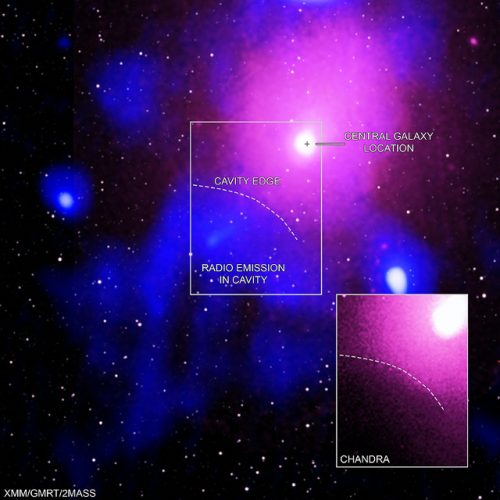
The outburst region in the Ophiuchus supercluster

An article published in “The Astrophysical Journal” reports the observation of what was called the largest explosion discovered in the universe after the Big Bang and caused by the supermassive black hole in the galaxy at the center of the Ophiuchus supercluster. A team of astronomers led by Simona Giacintucci of the Naval Research Laboratory combined X-ray observations with ESA’s XMM-Newton and NASA’s Chandra space telescopes with those at radio frequencies conducted with Murchison Widefield Array (MWA) and Giant Metrewave Radio Telescope (GMRT) radio telescopes to map the cavity generated by that cataclysmic event, about 15 times the Milky Way’s size.

The Sombrero Galaxy

An article published in “The Astrophysical Journal” reports a study on the Sombrero Galaxy and in particular on its halo. A team of researchers used the Hubble space telescope, finding a surprising abundance of stars rich in heavy elements, and computer simulations to try to understand the origin of this galaxy difficult to catalog because it’s a hybrid between the elliptical and the spiral shapes. The conclusion is that its growth occurred from the merging of two or perhaps even more massive galaxies in a chaotic process.

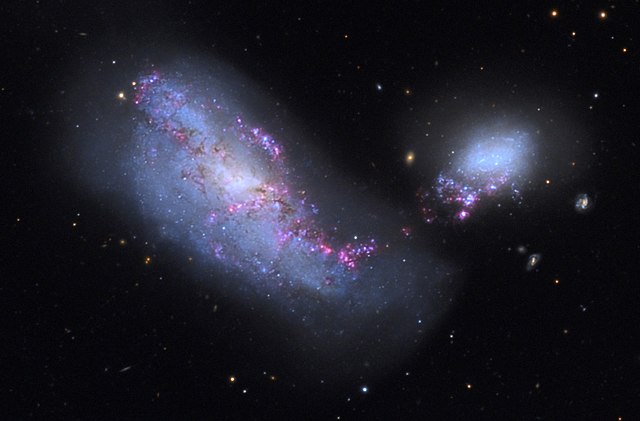
NGC 4490 and NGC 4485

An article accepted for publication in “The Astrophysical Journal” reports evidence that the galaxy NGC 4490 has a double nucleus. A team of researchers led by Allen Lawrence of Iowa State University studied data collected using various telescopes to find traces of two different nuclei in NGC 4490. One of the two nuclei can be seen at optical wavelengths, the other is hidden by dust and can be seen only at infrared and radio wavelengths, capable of passing through those dusts. Lawrence saw the double nucleus about seven years ago when he was an astronomy student even though at the time he was about 70 years old.