Galaxies

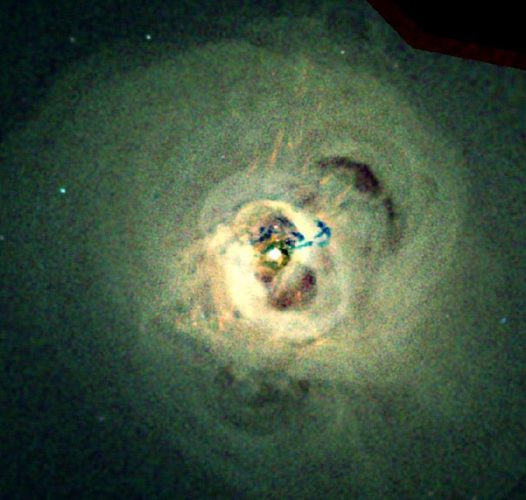
The center of the Perseus galaxy cluster (Image courtesy NASA/CXC/IoA/A.Fabian et al.)

An article published in the journal “Monthly Notices of the Royal Astronomical Society” reports the results of the study of molecular gas outflows in twelve massive galaxies at the center of galaxy clusters. A team of researchers analyzed data collected with the ALMA radio telescope to conduct this study finding that the active galactic nuclei (AGNs) of the observed galaxies cause periodic energy outbursts in the form of radiation or as jets of particles that move at speeds close to the speed of light. The energy releases cause gas outflows which can be pushed even beyond the galaxy borders. This mechanism limits the approach of the gas to the central supermassive black hole, decreasing the outbursts in what’s called a feedback. The researchers are especially studying the consequences on star formation and the possibility that a galaxy might become quenching.

Fornax A with its lobes

An article published in the journal “Astronomy & Astrophysics” reports a study of the galaxy known as Fornax A or as NGC 1316. A team of researchers led by Filippo Maccagni of the Italian National Institute of Astrophysics, Cagliari, used data collected by five different telescopes to find evidence of repeated nuclear activity that formed what were called radio lobes, gigantic plasma halos invisible at optical frequencies but bright at radio frequencies. For this reason, the MeerKat radio telescope was crucial in obtaining the best observations ever obtained by Fornax A.

A portion of the Subaru/XMM-Newton Deep Field with a dying galaxy in the middle (Image courtesy NAOJ/M. Tanaka)

Two articles, one published in “The Astrophysical Journal Letters” and one in “The Astrophysical Journal”, report the results of studies on ancient quenching galaxies, which means that they strongly reduced or even finished their star-formation activity. Two teams of researchers with many of them in common used data collected with various telescopes to study these galaxies and establish that we see the oldest as it was about 1.5 billion years after the Big Bang. These studies offer new information to improve galaxy formation models.

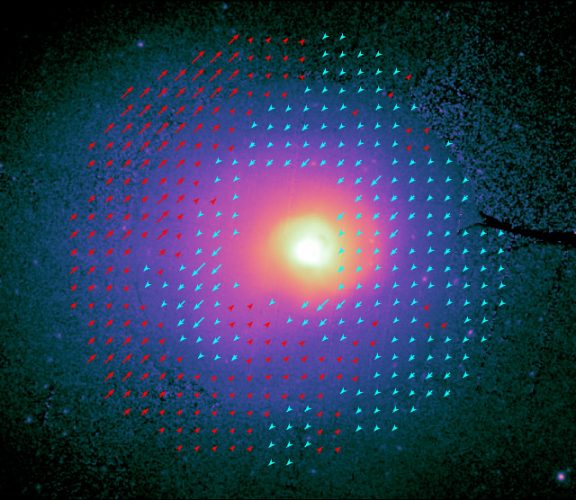
A map of plasma motions in the Perseus and Coma galaxy clusters

An article published in the journal “Astronomy & Astrophyiscs” reports the mapping of the distribution and motion of hot gas within the Perseus and Coma galaxy clusters. A team of researchers led by Jeremy Sanders of the Max Planck Institute for extraterrestrial physics in Garching, Germany, used in particular ESA’s XMM-Newton space telescope to study those two large clusters and detect the gas that, at very high temperatures and in the form of a plasma, shines at X-rays. This mapping offers new information on the formation and evolution of galaxy clusters.

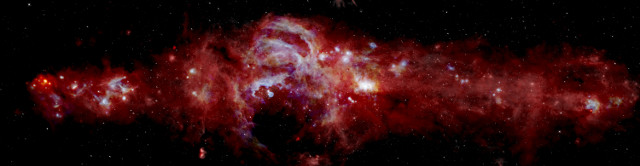
New details of the center of the Milky Way observed by the SOFIA flying telescope

An article submitted for publication in “The Astrophysical Journal” reports the initial results of an investigation about the center of the Milky Way conducted using the SOFIA flying telescope to capture infrared details never seen before and therefore useful for mapping an area 600 light years across. A team of researchers integrated those observations with data previously collected using NASA’s Spitzer space telescope and ESA’s Herschel space observatory obtaining a map of the center of the galaxy useful for example to understand where gas is concentrated which can lead to the new stars’ formation, how some of the most massive stars in the Milky Way formed in a relatively small region or where materials are likely to be devoured by the supermassive black hole at the center of the galaxy.