Galaxies

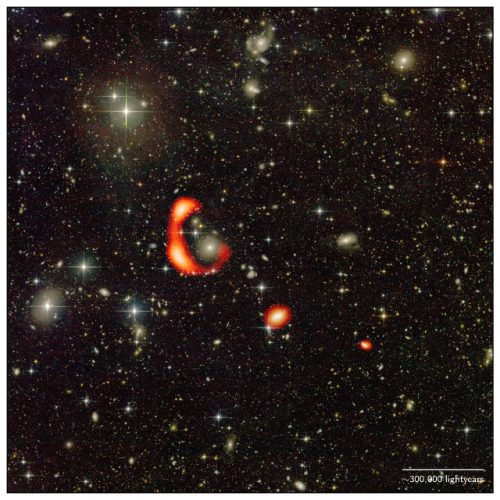
The galaxy AGC 203001 is the most visible thanks to the huge red ring

An article published in the journal “Monthly Notices of the Royal Astronomical Society” reports the discovery of a giant neutral hydrogen ring surrounding a “quenched galaxy” cataloged as AGC 203001. A team of astronomers from the National Center for Radio Astrophysics (NCRA) in Pune, India, used the Giant Metrewave Radio Telescope (GMRT) to observe that ring, much larger than the galaxy itself with a diameter of about 380,000 light years, four tiems the Milky Way’s. The collaboration of French astronomers allowed a further study with the Canada-France-Hawaii-Telescope (CFHT) in Hawaii, USA, which found no signs of stars associated with the ring, an oddity considering that such a structure seems perfect as a nursery for new stars.

A whole galaxy cluster influenced by the activity of a supermassive black hole

An article published in “The Astrophysical Journal” reports a study on a supermassive black hole in the galaxy cluster SPT-CLJ0528-5300 or simply SPT-0528 that had a really extraordinary outburst. A team of researchers used in particular NASA’s Chandra X-ray Observatory to study that activity finding that the materials pushed away created two huge cavities 180° from each other. By measuring the volume and pressure of the displaced gas and calculating the age of the cavities, it was possible to estimate the energy of that activity in over 1054 joules, the highest discovered so far in a distant cluster. It could be the cause of a limited star formation in clusters like this one.

MAMBO-9 is a dusty galaxy 13 billion light years away

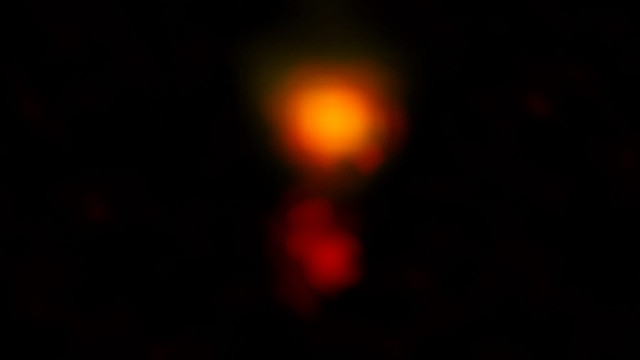
An article published in “The Astrophysical Journal” reports a study on a dusty early galaxy known as MAMBO-9. A team of researchers led by Caitlin Casey of the University of Texas at Austin used the ALMA radio telescope to study this galaxy about 13 billion light years away and its star formation rate much higher than the Milky Way’s. The observations showed that actually they’re two galaxies during a merger. That’s all useful to understand the role of dusty galaxies like that one in the evolution of the universe.

The galaxy NGC 6240 contains three supermassive black holes

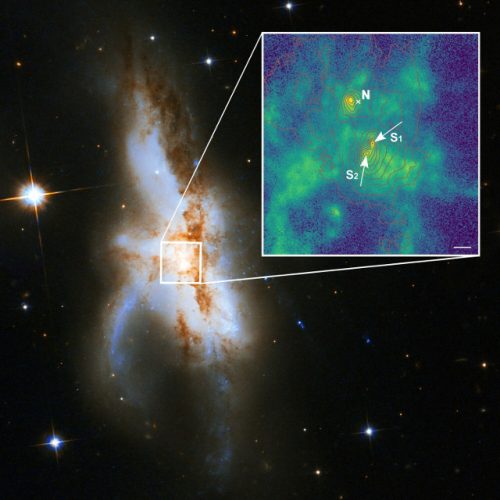
An article published in the journal “Astronomy & Astrophysics” reports a study on the galaxy NGC 6240 with evidence that it contains three supermassive black holes. A team of researchers led by Professor Wolfram Kollatschny of the University of Göttingen used the MUSE instrument mounted on ESO’s VLT in Chile together with data from previous studies to obtain the high-precision observations needed to verify that within NGC 6240 there were not two supermassive black holes as it seemed from previous studies but three. This indicates that the current merger is involving three galaxies.

The center of the Milky Way seen in detail by the MWA radio telescope

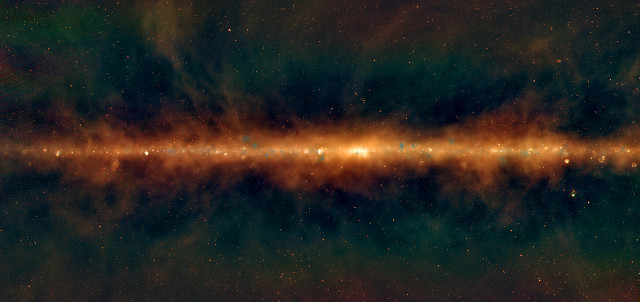
Three articles published in the journal “Publications of the Astronomical Society of Australia (PASA)” report some results of the GaLactic and Extragalactic All-sky MWA (GLEAM) survey. A team of researchers created some images obtained thanks to the Murchison Widefield Array (MWA) radio telescope showing the center of the Milky Way. Thanks to the low-frequency radio emissions detected, it was possible to generate an image that reproduces both the larger structures and the details. This means that it was possible to obtain an overall image and images of individual objects such as 27 supernova remnants.