Galaxies

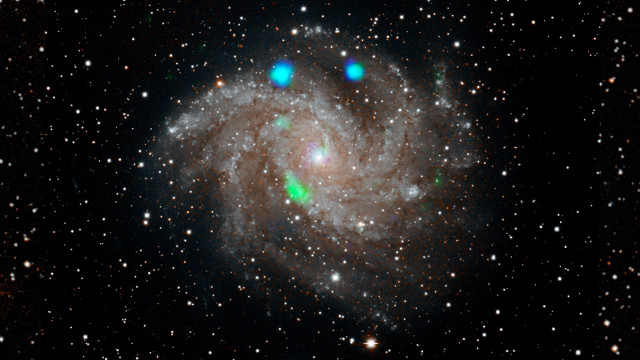
The galaxy NGC 6946 and its ULXs (Image NASA/JPL-Caltech)

An article published in “The Astrophysical Journal” reports a study on some ultraluminous X-ray sources observed in the galaxy NGC 6946. A team of researchers led by Hannah Earnshaw, a postdoctoral researcher at Caltech, used observations carried out with NASA’s NuSTAR space telescope of. In particular, their interest focused on one of the sources, cataloged as ULX-4, also observed with ESA’s XMM-Newton space telescope but after ten days NASA’s Chandra X-ray Observatory found no more traces of it. Such an event usually has a long duration so it could have been generated by a black hole or a neutron star on nearby debris.

39 ancestors of massive elliptical galaxies discovered in the early universe

An article published in the journal “Nature” reports the discovery of 39 galaxies in the early universe. A team of researchers combined data from different telescopes to identify a group of galaxies dating back to the first two billion years after the Big Bang that were invisible to previous observations in their areas conducted at optical frequencies. Their study could offer new information on the evolution of galaxies, on the supermassive black holes at their center and also on the distribution of dark matter.

A heavily obscured primordial supermassive black hole discovered

An article published in the journal “Astronomy & Astrophysics” reports the discovery of a supermassive black hole in an initial phase of growth in which it’s heavily obscured and that dates back to around 850 million after the Big Bang, the oldest of that type discovered so far. A team of researchers used data collected by NASA’s Chandra X-ray Observatory to carry out this study but even putting together other data collected with the ALMA radio telescope it’s not certain whether that black hole matches the quasar cataloged as PSO167-13 or a nearby galaxy.

The galaxy Holmberg 15A (Image courtesy Juan P. Madrid & Carlos J. Donzelli)

An article submitted for publication in “The Astrophysical Journal” reports the discovery of an ultramassive black hole at the center of the galaxy Holmberg 15A, a supergiant elliptical galaxy that is the dominant central member of the Abell 85 galaxy cluster. A team of astronomers led by Kianusch Mehrgan of the Max Planck Institute for Extraterrestrial Physics, Garching bei München, Germany, used the MUSE instrument mounted on ESO’s VLT in Chile to study that galaxy estimating that the mass of that black hole is about 40 billion times the Sun’s.

Galaxy NGC 3147 (Image ESA/Hubble & NASA, A. Riess et al.)

An article published in the journal “Monthly Notices of the Royal Astronomical Society: Letters” reports a study on a supermassive black hole surrounded by a disk of materials that revealed unexpected features. A team of researchers led by Stefano Bianchi, of the University of Roma Tre, Italy, used the Hubble Space Telescope to observe the nucleus of the galaxy NGC 3147 discovering a small and soft disk, a reduced version of the large disks typical of active galactic nuclei, a structure that shouldn’t exist. The discovery represents a new opportunity to test some relativistic effects but could force astronomers to review certain models on active galactic nuclei.