Galaxies

Artist's impressione of the Milky Way and the Sausage dwarf galaxy (Image courtesy V. Belokurov (Cambridge, UK); Based on image by ESO/Juan Carlos Muñoz)

A series of articles published in the journals “Monthly Notices of the Royal Astronomical Society” and “The Astrophysical Journal Letters” or on the arXiv website describe various aspects of a study on the consequences of the merger of the Milky Way and a dwarf galaxy nicknamed Sausage. A team of astronomers used data collected by ESA’s Gaia space probe to reconstruct that event from 8-10 billion years ago that profoundly influenced the Milky Way.

MRK 1216

An article to be published in the journal “Monthly Notices of the Royal Astronomical Society” describes a research on isolated galaxies with a mass similar to the first elliptical galaxies but much smaller in which the central supermassive black hole inhibited stellar formation and grew more than normal. A team of researchers used data collected by NASA’s Chandra X-ray Observatory to examine the galaxies MRK 1216 and PGC 032873, nicknamed red nuggets, relics of the first massive galaxies that formed in the first billion years after the Big Bang.

Artist's concept of the blazar OJ 287

An article published in the journal “Monthly Notices of the Royal Astronomical Society” describes a research on a blazar, a type of active galactic nucleus, known as OJ 287. A team of researchers led by Silke Britzen of the Max Planck Institute for Radio Astronomy (MPIfR) in Bonn, Germany, studied this blazar, which has long been known and left the astronomers puzzled by its variations in brightness. The cause could be in the presence of two black holes or a misaligned accretion disk.

The galaxy ESO325-G004 and the Einstein ring (Image ESO, ESA/Hubble, NASA)

An article published in the journal “Science” describes the most precise verification of Albert Einstein’s general theory of relativity outside the Milky Way. A team of researchers led by Thomas Collett of the Institute of Cosmology and Gravitation at the British University of Portsmouth used data collected by the Hubble Space Telescope and ESO’s VLT to observe a gravitational lensing effect, one of the relativistic predictions, created by the galaxy ESO325-G004. The two instruments provided separate data that, compared, confirmed the correctness of the theory.

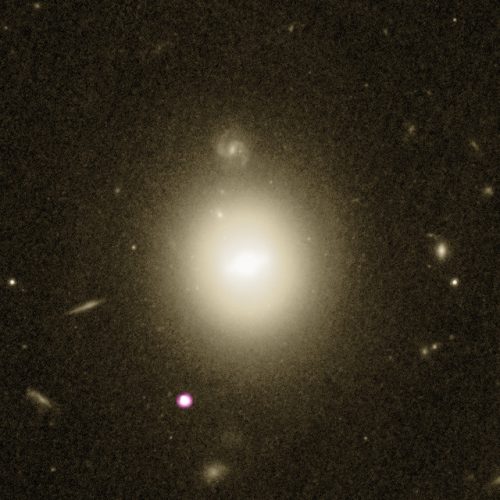
The galaxy galaxy 6dFGS gJ215022.2-055059 and the intermediate-mass black hole candidate

An article published in the journal “Nature Astronomy” describes the discovery of the best candidate found so far for a type of black hole that’s been elusive for a long time. A team led by Dacheng Lin of the University of New Hampshire’s Space Science Center used observations from a number of telescopes to detect flares at various wavelengths emitted in the area near an intermediate-mass black hole while destroying a nearby star in what is called the tidal disruption event.