Galaxies

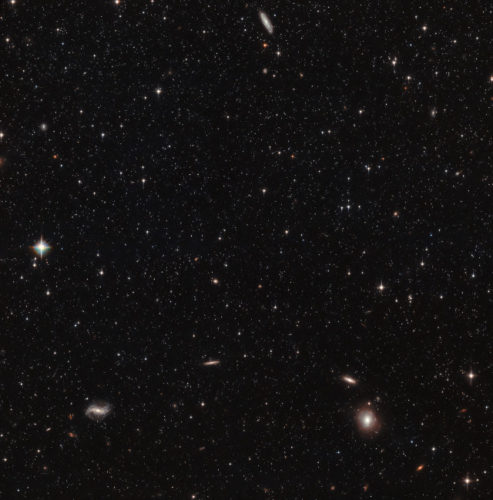
The galaxy cluster RCS2 J2327 (Image ESO & ESA/Hubble & NASA)

An article accepted for publication in the journal “Astronomy & Astrophysics” describes a research on the galaxy cluster RCS2 J2327-0204, or simply RCS2 J2327. A team of researchers combined observations carried out with the HAWK-I instrument installed on the VLT (Very Large Telescope) and with the Hubble Space Telescope’s ACS instrument to measure the distortions caused by the gravitational lens effects of the cluster estimating its mass in about 2 quadrillion times the Sun’s.

The Quasar J1342+0928 (Image courtesy Mpia / Venemans et al.)

Two articles, one published in the journal “Nature” and one published in the “Astrophysical Journal Letters”, describe different aspects of a research that led to the discovery of the oldest known supermassive black hole. According to an estimate it formed about 690 million years after the Big Bang and it’s difficult to explain how it reached 800 million times the Sun’s mass. Labeled as Ulas J134208.10+092838.61 or more simply as J1342+0928, it may have formed during the so-called reionization period.

Hubble Ultra Deep Field galaxies seen by MUSE (Image ESO/MUSE HUDF collaboration)

A series of 10 articles to be published in the journal “Astronomy & Astrophysics” describes various aspects of the deepest spectroscopic investigation ever carried out with the MUSE instrument installed on ESO’s Very Large Telescope (VLT) in Chile. An international team with many researchers focused on the Hubble Space Telescope’s Ultra Deep Field (HUDF) to measure distances and properties of 1,600 very dim galaxies, of which 72 were never detected before.

A part of the Sculptor Dwarf Galaxy (Image ESA/Hubble & NASA)

An article published in the journal “Nature Astronomy” reports the reconstruction of the 3D movements of 10 stars in the Sculptor Dwarf Galaxy selected within a larger sample of over 100 among those with the smallest measurement errors. A team of researchers used observations made using the Hubble Space Telescope in 2002 and subsequent observations carried out by ESA’s Gaia space probe between 2014 and 2015 to produce this reconstruction that confirms the “cold” dark matter model.