
Galaxies

The globular cluster Terzan 5 seen by the MAD on the VLT (Image ESO/F. Ferraro)

An article published in “The Astrophysical Journal” describes a research on the globular cluster Terzan 5. An international team of astronomers led by Francesco Ferraro from the University of Bologna discovered that the stars of Terzan 5 are divided into two groups, one with an age of 12 billion years and one with an age of around 4.5 billion years, more or less like the Sun. This unique feature can help to better understand the evolution of the Milky Way.

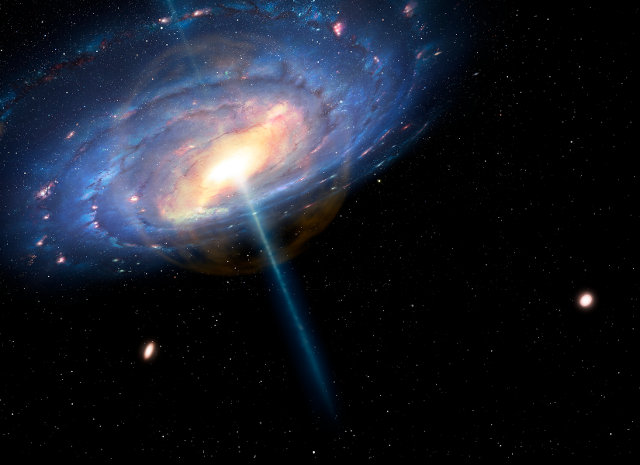
Artistic concept of the Milky Way as a Quasar (Image courtesy Mark A. Garlick/CfA)

An article published in “The Astrophysical Journal” describes a research about the Milky Way that offers a solution to the problem of the missing mass. A team of scientists led by Fabrizio Nicastro, a research associate at the Harvard-Smithsonian Center for Astrophysics (CfA) and astrophysicist at the Italian National Institute of Astrophysics (INAF), used ESA’s XMM-Newton space telescope to discover a kind of gaseous fog that absorbs emissions from distant sources. The existence of such a bubble indicates that some millions of years ago the Milky Way was a quasar.

Simulation of the large-scale structure of the universe (Image Nico Hamaus, Universitäts-Sternwarte München, courtesy of The Ohio State University)

An article accepted for publication in the journal “Physical Review Letters” describes a research on the distribution of matter in the universe made in a way different from usual. An international team of researchers studied cosmic voids as if they were photographic negatives from which they could get information about ordinary matter, dark energy and dark matter.

The area around dwarf galaxy DDO 68 with a possible satellite seen by LBT (Image courtesy Francesca Annibali/INAF)

An article published in “The Astrophysical Journal Letters” describes a research about the dwarf galaxy DDO 68. An international team of researchers led by Francesca Annibali of the National Institute for Astrophysics (INAF), Italy, used the Large Binocular Telescope (LBT) to make observations that allowed to find evidence that even a very small galaxy can capture smaller galaxies.