Launches

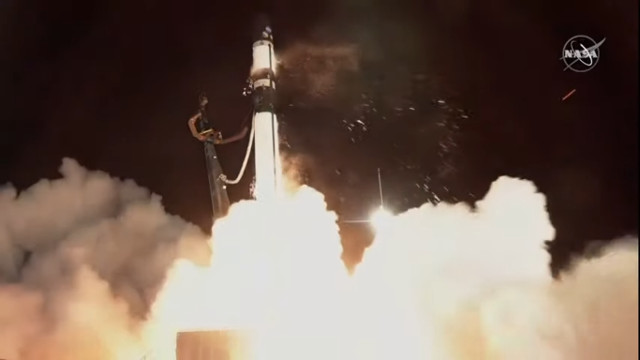
The CAPSTONE satellite blasting off atop an Electron rocket (Image NASA TV)

A little while ago, NASA’s CAPSTONE satellite was launched atop a Rocket Lab Electron rocket from the base in New Zealand. For about six days, the rocket’s upper Photon stage will carry CAPSTONE toward the Moon and then separate and let it travel for more than four months. Eventually, this CubeSat-class satellite will enter a so-called near-rectilinear halo orbit (NRHO) to study its dynamics for at least six months. This is the orbit into which NASA’s Lunar Gateway, a crucial element of the Artemis program, is scheduled to be placed, so there’s the need to check for unexpected problems, which includes communications.

The Shenzhou 14 mission starts blasting off atop a Long March-2F rocket (Photo courtesy Xinhua/Li Gang)

The confirmation has arrived that three Chinese taikonauts of the Shenzhou 14 mission have reached the Chinese space station’s Tianhe core module with an automated docking maneuver. They blasted off about seven hours earlier atop a Long March-2F rocket from the Jiuquan Satellite Launch Center. They’re the third crew of the Chinese space station and will remain there for about six months, the standard duration for a mission.

The Progress MS-20 spacecraft approaching the International Space Station (Image NASA TV)

A few hours ago, the Progress MS-20 spacecraft blasted off atop a Soyuz 2.1a rocket from the Baikonur Cosmodrome in Kazakhstan. After about nine minutes it successfully separated from the rocket’s last stage and was placed on its ultra-fast track in its resupply mission to the International Space Station also called Progress 81 or 81P. After almost 3.5 hours it reached the International Space Station docking with its Zvezda module.

Boeing's CST-100 Starliner spacecraft blasting off atop a ULA Atlas V rocket in its Boe-OFT 2 mission (Photo Boeing/John Proferes)

A few hours ago, Boeing’s CST-100 Starliner spacecraft blasted off atop a ULA Atlas V rocket from Cape Canaveral on the Boe-OFT 2 (Boeing Orbital Flight Test 2) mission. After about fifteen minutes it successfully separated from the rocket’s last stage and about half an hour after launch it carried out the maneuvers to enter orbit and begin the pursuit of the International Space Station.

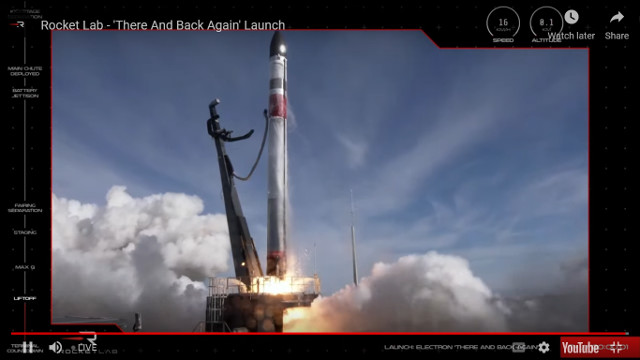
The Electron rocket starts "There And Back Again" mission (Image courtesy Rocket Lab)

A few hours ago, Rocket Lab’s first attempt to use a Sikorsky S-92 helicopter to catch the first stage of its Electron rocket while it was returning to the ground during a mission called “There And Back Again” was successful. The goal is a controlled transport of the first stage to the ground in order to reuse it. After catching it, the pilot found that the load had different characteristics from those experienced during the tests and let go of the first stage, which splashed down and was recovered by Rocket Lab’s ship.