Launches

Boeing's CST-100 Starliner spacecraft blasting off atop a ULA Atlas V rocket in its Boe-OFT 2 mission (Photo Boeing/John Proferes)

A few hours ago, Boeing’s CST-100 Starliner spacecraft blasted off atop a ULA Atlas V rocket from Cape Canaveral on the Boe-OFT 2 (Boeing Orbital Flight Test 2) mission. After about fifteen minutes it successfully separated from the rocket’s last stage and about half an hour after launch it carried out the maneuvers to enter orbit and begin the pursuit of the International Space Station.

The Electron rocket starts "There And Back Again" mission (Image courtesy Rocket Lab)

A few hours ago, Rocket Lab’s first attempt to use a Sikorsky S-92 helicopter to catch the first stage of its Electron rocket while it was returning to the ground during a mission called “There And Back Again” was successful. The goal is a controlled transport of the first stage to the ground in order to reuse it. After catching it, the pilot found that the load had different characteristics from those experienced during the tests and let go of the first stage, which splashed down and was recovered by Rocket Lab’s ship.

SpaceX's Crew Dragon Freedom spacecraft starting its Crew-4 mission blasting off atop a Falcon 9 rocket (Image NASA TV)

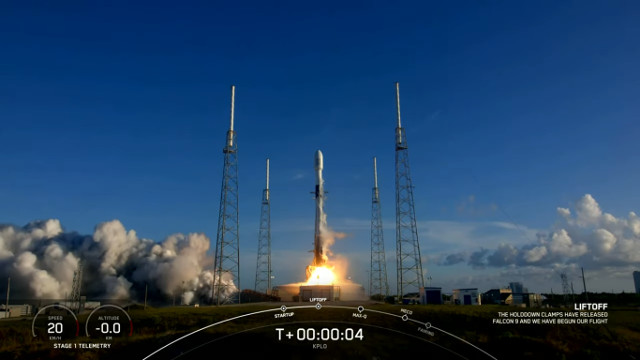
A little while ago, SpaceX’s Crew Dragon Freedom spacecraft blasted off atop a Falcon 9 rocket from the Kennedy Space Center in its Crew-4 or SpaceX Crew-4 mission with Robert Hines, Samantha Cristoforetti, Jessica Watkins, and Kjell Lindgren . After about eleven minutes, it successfully separated from the rocket’s last stage and went en route to carry out its mission. This is the 4th crewed mission of the Crew Dragon spacecraft within the normal rotation of the International Space Station crew. This is also the first mission for the Freedom.

SpaceX Crew Dragon Endeavor starting its Ax-1 mission blasting off atop a Falcon 9 rocket (Image NASA TV)

A little while ago, the SpaceX Crew Dragon Endeavor spacecraft blasted off atop a Falcon 9 rocket from the Kennedy Space Center in the Axiom Mission 1 or simply Ax-1 mission. After about twelve minutes it successfully separated from the rocket’s last stage. It will spend approximately 10 days in orbit which includes 8 days on the International Space Station. Unlike the private space missions conducted last year, the Ax-1 also has commercial purposes in a collaboration between SpaceX, Axiom Space, and NASA to access the Station for the purpose of conducting work useful for the development of new technologies and scientific research.

The Soyuz MS-21 spacecraft (at the center) docked with the International Space Station (Image NASA TV)

A few hours ago, the Soyuz MS-21 spacecraft was launched from the Baikonur Cosmodrome in Kazakhstan and after a little more than three hours reached the International Space Station with three new crew members on board. It docked with the Station’s Prichal module. As is becoming increasingly common for crewed trips as well, the ultra-fast track was used which halves the journey duration.