Launches

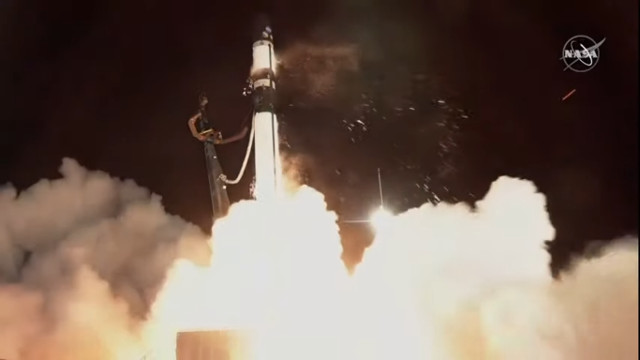
The Cygnus S.S. Piers Sellers cargo spacecraft blasting off atop an Antares rocket (Image NASA TV)

A little while ago, Northrop Grumman’s Cygnus spacecraft blasted off atop an Antares rocket from the Mid-Atlantic Regional Spaceport (MARS), part of NASA’s Wallops Flight Facility (WFF) on Wallops Island. After about nine minutes it successfully separated from the rocket’s last stage went en route to its destination. This is its 17th official mission, called NG-17 or CRS NG-17, to transport supplies to the International Space Station for NASA.

The Progress MS-19 cargo spacecraft blasting off atop a Soyuz-2.1a rocket (Image courtesy Roscosmos)

A few hours ago, the Progress MS-19 spacecraft blasted off atop a Soyuz-2.1a rocket from the Baikonur Cosmodrome in Kazakhstan. After about nine minutes it successfully separated from the rocket’s last stage and was placed on its route. The cargo spacecraft began its resupply mission to the International Space Station also called Progress 80 or 80P. In this mission, the route used is the one that requires about two days.

The James Webb Space Telescope blasting off atop an Ariane 5 ECA rocket (Image NASA TV)

A little while ago, the James Webb Space Telescope was launched atop an Ariane 5 ECA rocket from the Kourou base, French Guiana. After about 27 minutes it successfully separated from the rocket’s last stage and began its journey to the area known as L2, about 1.5 million kilometers from Earth. During the journey, its structure will be deployed and instrument tests and calibrations will begin. That’s a long preparation phase that will continue even after the telescope has reached its destination. The launch has put a strain on the possibilities of one of the most powerful and reliable rockets available but was only the first in a series of critical steps required to begin the work of this extremely sophisticated instrument.

The IXPE space telescope blasting off atop a Falcon 9 rocket (Photo NASA/Joel Kowsky)

A few hours ago, the NASA and Italian Space Agency IXPE space telescope was launched on a Falcon 9 rocket from the Cape Canaveral base. After just over 33 minutes it successfully separated from the rocket’s last stage and made the necessary maneuvers to enter an equatorial orbit at an altitude of about 600 kilometers. There, after having extended its structure and after the test phase, it will begin its scientific mission to measure the polarization of cosmic X-rays, the first instrument of this type.

The Prichal module blasting off atop a Soyuz 2.1b rocket (Photo courtesy RSC Energia)

Yesterday, the Russian Prichal module, also known as Uzlovoy Module (UL), was launched atop a Soyuz 2.1b rocket from the Baikonur Cosmodrome, Kazakhstan. After a little more than nine minutes, it successfully separated from the rocket’s last stage and set off on its course. Its journey will take just over two days to reach the International Space Station, on November 26, where it will become part of the Russian section many years behind schedule. Prichal will be driven to its destination by a modified Progress cargo spacecraft.