Launches

The Hope space probe blasting off atop an H-IIA rocket (Image courtesy MHI / JAXA)

A few hours ago the Arab space probe Hope, or Al Amal, was launched atop an H-IIA rocket from the Tanegashima space center in Japan. About an hour after the launch, Hope regularly separated from the rocket’s last stage and went on the route that is scheduled to take it to the planet Mars’ orbit in February 2021. The communication of the solar panel deployment had a few minutes of delay, and that caused concern at the mission control center at the Mohammed bin Rashid Space Centre, but in the end, everything went well.

The Crew Dragon spacecraft starts its SPX-DM2 mission blasting off atop a Falcon 9 rocket (Image NASA TV)

A little while ago SpaceX’s Crew Dragon spacecraft blasted off atop a Falcon 9 rocket from Cape Canaveral in its SpX-DM2 (SpaceX Demonstration Mission 2) or SpaceX Demo-2 mission. After about eleven minutes, it successfully separated from the rocket’s last stage and went en route to carry out its mission. This is the first crewed mission of the Crew Dragon spacecraft, in this case with Doug Hurley and Bob Behnken on board.

The HTV-9 spacecraft blasting off atop a H-IIB rocket (Image courtesy JAXA)

A little while ago the HTV-9 spacecraft blasted off atop a H-IIB rocket from the Tanegashima space center in Japan for a resupply mission to the International Space Station. About fifteen minutes after the launch, the cargo spacecraft separated regularly from the rocket’s last stage, entered its preliminary orbit and deployed its solar panels and navigation antennas.

The Progress MS-14 cargo spacecraft blasting off atop a Soyuz 2.1a rocket (Image NASA TV)

A few hours ago the Progress MS-14 spacecraft blasted off atop a Soyuz 2.1a rocket from the Baikonur Cosmodrome in Kazakhstan. After about nine minutes it successfully separated from the rocket’s last stage and was placed on its ultra-fast track in its resupply mission to the International Space Station also called Progress 75 or 75P. After almost 3.5 hours it reached the International Space Station docking with its Zvezda module.

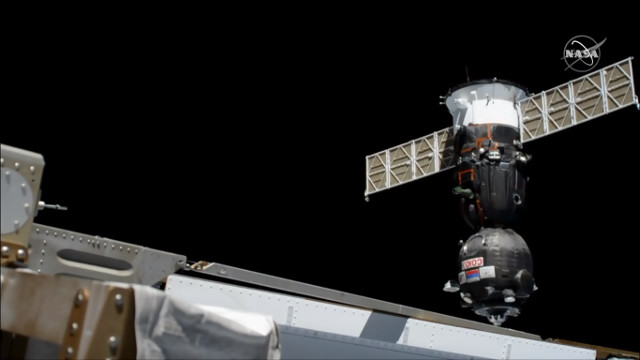
The Soyuz MS-16 spacecraft docking with the International Space Station (Image NASA TV)

A little while ago the Soyuz MS-16 spacecraft was launched from the Baikonur Cosmodrome in Kazakhstan and after a little more than six hours reached the International Space Station with three astronauts on board. In the period preceding a launch, it’s normal for astronauts and cosmonauts to remain in quarantine. In this case it was also extended to the personnel who managed the launch, with limits to the people who could have been in Baikonur.