Moons

The Moon shines in gamma rays

An analysis of the Moon’s gamma-ray brightness performed by Mario Nicola Mazziotta and Francesco Loparco of the National Institute of Nuclear Physics, Bari, Italy, using NASA’s Fermi Gamma-ray Space Telescope’s Large Area Telescope (LAT) instrument revealed that at certain electromagnetic wavelengths the Moon is brighter than the Sun. It’s the result of the interaction of the Moon with cosmic rays so the observations of those gamma rays offer new information on very energetic cosmic events but also on the Moon’s environment. Studying that environment has become more important following the new projects of manned Moon missions.

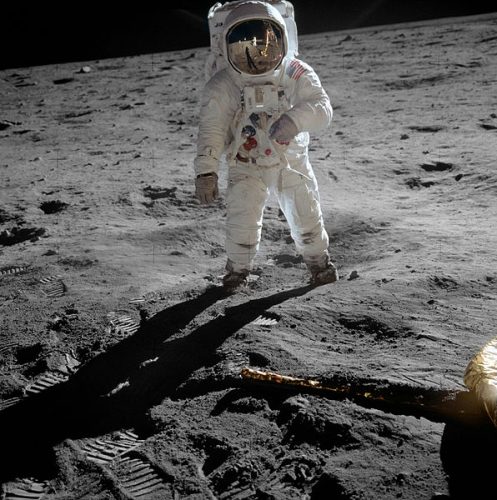
Buzz Aldrin photographed by Neil Armstrong, visible in the helmet's reflection (Photo NASA)

On July 20, 1969, NASA’s Apollo 11 mission’s lunar module Eagle, started on July 16, accomplished the first Moon landing of a manned spacecraft. Mission commander Neil Armstrong and lunar module pilot Edwin “Buzz” Aldrin participated in the landing and spent just over two hours on the surface of the Moon to collect some samples that were brought back to Earth. Once they departed the Moon, the two astronauts rejoined Michael Collins, who remained in orbit in the command module Columbia and returned to Earth on July 24th.

An explanation for the scarce presence of gold and other rare elements on the Moon

An article published in the journal “Nature” offers a possible explanation of the remarkable difference in the presence of some chemical elements on the Earth and on the Moon still accepting the theory of their common origin following an impact with the primordial Earth. A team of researchers carried out a series of simulations of the impacts that could have happened on the Moon during the first phase of its history, concluding that the retention of the elements classified as highly siderophilous began 4.35 billion years ago, at the time when most of the magma that covered the lunar surface solidified.

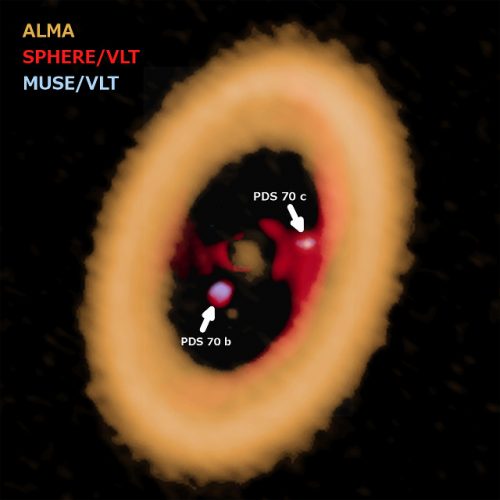
Possible moons in formation around the exoplanet PDS 70 c

An article published in the journal “The Astrophysical Journal Letters” reports the observation of what is interpreted as a circumplanetary disk in the system of the young star PDS 70. A team of researchers led by Andrea Isella of Rice University in Houston, Texas, used the ALMA radio telescope to detect the emissions of that disk that surrounds the exoplanet PDS 70 c and according to the astronomers is of the type that controls the formation of planets and of a system of moons such as those around the planet Jupiter.

Titan northern hemisphere (Image NASA / JPL-Caltech / Space Science Institute)

At the 2019 Astrobiology Science Conference being held in Bellevue, Washington, Morgan Cable of NASA’s JPL presented the results of a study conducted with other researchers on Titan, Saturn’s largest moon. This team recreated in lab some conditions existing in the lakes of methane and other hydrocarbons of Titan, discovering that a co-crystal of solid acetylene and butane could be produced with the formation of ring-shaped deposits around those lakes similarly to salt deposits which are produced when water evaporates in the Earth’s seas. Those co-crystals could be used by exotic life forms in a way similar to carbon dioxide on Earth.