Moons

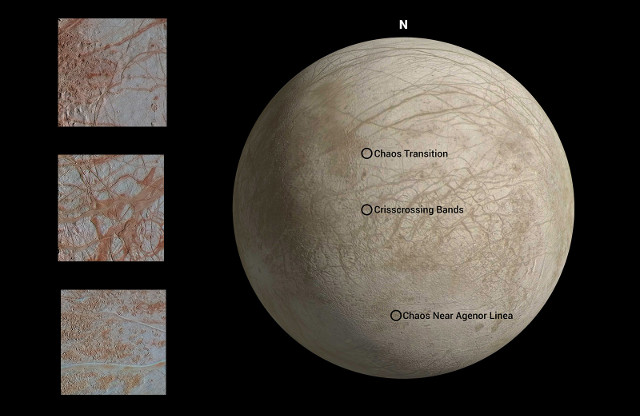
Europa seen by the Galileo space probe

NASA has published reprocessed versions of three old photos of areas of the surface of Jupiter’s large moon Europa taken by the Galileo space probe on September 26, 1998. NASA scientists applied some processing techniques developed in recent years to the images obtaining new details of a series of geological features existing at the time on Europa’s frozen surface. This result offers is immediately useful for scientists interested in studying this moon and for the future because NASA is preparing the Europa Clipper mission, which also aims to try to understand what’s hidden in Europa’s underground ocean, with the hope to find life forms.

Titan (NASA/JPL-Caltech/Space Science Institute)

An article published in “The Astrophysical Journal” reports a study of the chemical compounds in the atmosphere of Titan, Saturn’s great moon. Takahiro Iino of the University of Tokyo, together with Hideo Sagawa of Kyoto Sangyo University and Takashi Tsukagoshi of NRAO (National Astronomical Observatory of Japan) used the ALMA radio telescope to detect the chemical signatures of the compounds existing on Titan discovering that of acetonitrile, including a rare isotopomer that contains nitrogen-15.

Titan's dunes (Image courtesy University of Hawaii at Manoa)

An article published in the journal “Science Advances” reports a study that offers some answers to the mystery of the origin and composition of the dunes on Titan, one of the moons of the planet Saturn particularly interesting for many reasons that include the formation of many organic compounds. A team of researchers led by physical chemist Ralf I. Kaiser of the University of Hawaii at Manoa examined data collected during the Cassini-Huygens mission and computer simulations whose results indicate that acetylene exposed to cosmic rays can form materials that make up Titan’s dunes.

New organic compounds discovered on Saturn's moon Enceladus

An article published in the journal “Monthly Notices of the Royal Astronomical Society” reports the identification of organic compounds on Enceladus, the moon of Saturn which became famous in the last decade after the discovery of an underground ocean. A team of researchers led by Nozair Khawaja used data collected by the Cassini space probe’s Cosmic Dust Analyzer (CDA) to identify compounds that could be (di)methylamine, ethylamine and carbonyls in ice grains from the surface of Enceladus. They aren’t the first organic compounds that are formed on Enceladus and represent another interesting discovery in the search for life forms on that moon.

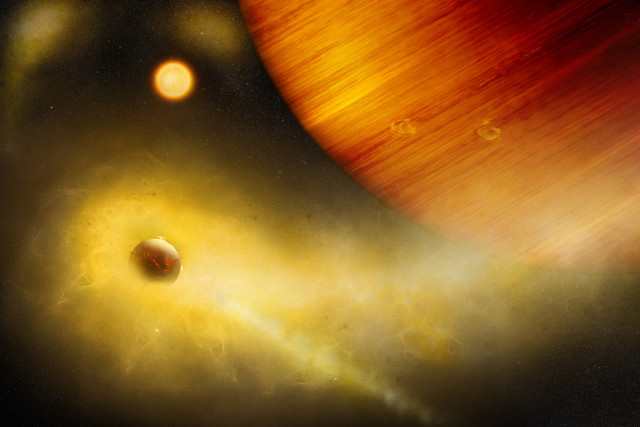
Artist's concept of an exo-Io orbiting a hot Jupiter (Image courtesy University of Bern. Illustration Thibaut Roger)

An article accepted for publication in “The Astrophysical Journal” reports on traces of sodium and potassium in the orbit of the gas giant exoplanet WASP-49b. A team of researchers coordinated by the Swiss University of Bern compared the situation of WASP-49b to Jupiter and its moon Io, known for its remarkable volcanic activity, noting that there are important clues to the fact that WASP-49b also has a volcanic moon with an activity that includes the ejection of sodium and potassium.