NASA

Picture of the lonly mountain on Ceres taken by the Dawn space probe (Photo NASA/JPL-Caltech/UCLA/MPS/DLR/IDA)

NASA’s Dawn spacecraft is carrying out a mapping of the dwarf planet Ceres and with its camera is capturing extraordinary images better than those available so far, with a resolution of 140 meters (450 feet) per pixel. Among the geological features photographed there’s a mountain about 6 kilometers (4 miles) high that had already intrigued scientists and public because it looks like a pyramid and its sides are covered with brilliant material.

The InSight lander in its protective aeroshell during the test stage (Photo NASA/JPL-Caltech/Lockheed Martin)

NASA invited people around the world to participate in an initiative to send your name to Mars. You just need to record some data on the page prepared by the Agency on its website to get a virtual boarding pass. All names will be recorded on a microchip that will be transported on the InSight lander, which is scheduled to be launched in March 2016 to land on Mars in September 2016.

Picture of the galaxy NGC 428 taken by the Hubble Space Telescope (Photo ESA/Hubble and NASA and S. Smartt (Queen's University Belfast))

A photograph of the galaxy NGC 428 taken by the Hubble Space Telescope shows its distorted and warped structure. Together with traces of a significant amount of stars being formed, it’s the sign of the merger between two galaxies. For this reason, its appearance could give us an idea of ​​what will happen in a few billion years to the Milky Way in its merger with Andromeda.

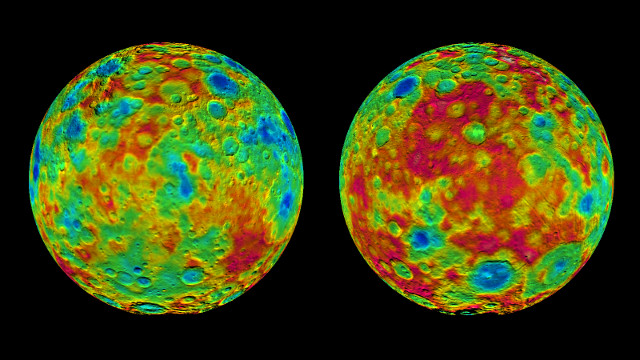
Topographic map of the dwarf planet Ceres (Image NASA/JPL-Caltech/UCLA/MPS/DLR/IDA)

NASA published the first topographic maps of the dwarf planet Ceres made using data collected by its Dawn space probe. They show a very diverse surface, full of craters and mountains with differences between the bottom of the craters and the mountain peaks that can reach 15 kilometers (about 9 miles). Meanwhile, the IAU (International Astronomical Union) approved a series of names for various geological features of Ceres.