
NASA

SpaceX's Crew Dragon Endeavour spacecraft blastin off atop a Falcon 9 rocket (Photo NASA/Frank Michaux)

A few hours ago, SpaceX’s Crew Dragon Endeavour spacecraft blasted off atop a Falcon 9 rocket from the Kennedy Space Center in its Crew-6 or SpaceX Crew-6 mission. After almost exactly twelve minutes, it successfully separated from the rocket’s last stage and went en route to carry out its mission. This is the 6th crewed mission of the Crew Dragon spacecraft within the normal rotation of the International Space Station crew. This is also the fourth mission for the Endeavour.

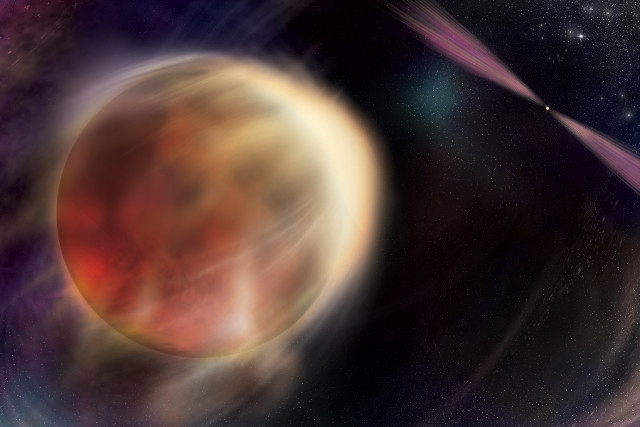
Artist's impression of a binary system containing a spider pulsar (Image NASA/Sonoma State University, Aurore Simonnet)

An article published in the journal “Nature Astronomy” reports the detection of gamma-ray eclipses in binary systems formed by a normal star or a brown dwarf that have a pulsar as a companion that is defined as a spider pulsar because they steal gas from the companion behaving like a black widow. A team of researchers used data collected over a decade by NASA’s Fermi Space Telescope to find cases in which the star passes in front of the pulsar. Seven binaries have been identified with a spider pulsar being eclipsed by its companion. This identification made it possible to measure the pulsar’s mass, a result useful to conduct tests on the theory of relativity and understand the behavior of matter in extreme conditions.

The new scheme of the orbits of the planets of the TOI 700 system

An article accepted for publication in “The Astrophysical Journal Letters” reports the discovery of the exoplanet TOI 700 e. A team of researchers used observations conducted with NASA’s TESS space telescope and confirmed with other instruments to find it. It’s the fourth planet discovered in the TOI 700 red dwarf system and is interesting because it’s a rocky planet a bit smaller than Earth. Its habitability potential is yet to be assessed because it’s within the so-called optimistic habitable zone, where a planet can only have liquid water on its surface for part of its history.

The Dragon cargo spacecraft departing the International Space Station to end its CRS-26 mission (Image NASA)

A little while ago, SpaceX’s Dragon spacecraft ended its CRS-26 (Cargo Resupply Service 26) mission for NASA splashing down smoothly off the Florida Coast. The Dragon left the International Space Station last Monday. For SpaceX, this was the 6th mission of the 2nd contract with NASA to transport supplies to the Station with the new version of the Dragon cargo spacecraft.

Shortly after the splashdown, SpaceX’s recovery ship went to retrieve the Dragon to transport it to the coast. The cargo brought back to Earth will be delivered to NASA within a few hours. The Dragon spacecraft reached the International Space Station on November 27, 2021.

Sand dunes covered by frost on Mars (Image NASA/JPL-Caltech/University of Arizona)

To celebrate the winter solstice on Earth and the start of winter in the northern hemisphere, NASA has released some photos captured on Mars by its Mars Reconnaissance Orbiter space probe’s HiRISE camera showing what some Martian areas look like when it’s winter on the red planet. Seeing snowfall is still beyond the possibilities of the available instruments but frozen or at least frost-covered landscapes show some of the marvels of Mars.