NASA

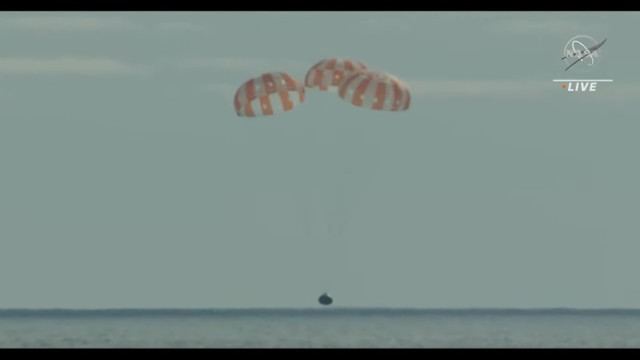
The NASA's Orion spacecraft splashing down

A little while ago, NASA’s Orion spacecraft completed its Artemis I mission by splashing down off the coast of the Baja California Peninsula, near Guadalupe Island. It blasted off on November 16 on the new SLS (Space Launch System), also NASA’s. Various ships were in the area to recover the Orion and every piece of hardware that can be recovered, such as the parachutes of the landing system, in order to collect as much data as possible on a critical phase such as the return to Earth.

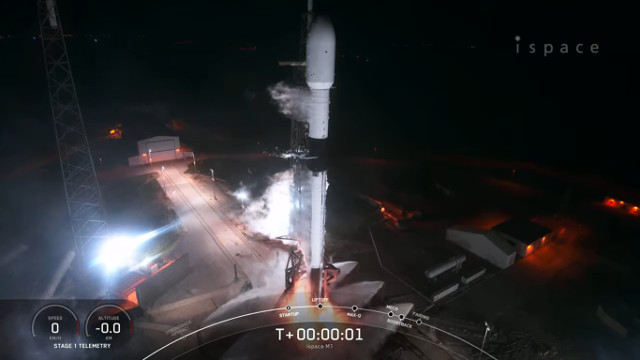
The Hakuto-R Moon lander and the Lunar Flashlight nanosatellite blasting off atop a Falcon 9 rocket (Image SpaceX)

A little while ago, ispace’s Hakuto-R Moon lander and NASA’s CubeSat-class nanosatellite Lunar Flashlight blasted off atop a Falcon 9 rocket from Cape Canaveral. After about 46 minutes, Hakuto-R successfully separated from the rocket’s last stage, and about 7 minutes later, Lunar Flashlight separated as well. Hakuto-R also carries two small rovers built by the United Arab Emirates and Japan. The route of what is called Hakuto-R Mission 1 will take about five months to get the lander to the Moon, where it will attempt a landing while the nanosatellite Lunar Flashlight will enter lunar orbit in about four months in search of water ice on its surface.

The Dragon 2 cargo spacecraft approaching the International Space Station in its CRS-26 mission (Image NASA TV)

A little while ago, SpaceX’s Dragon 2 spacecraft docked with the International Space Station’s Harmony module completing the first leg of its mission. It blasted off on a Falcon 9 rocket from the Kennedy Space Center in its CRS-26 (Cargo Resupply Service 26) mission, also referred to as SpX-2, on Saturday, when it was the afternoon in the USA. Astronauts Josh Cassada and Nicole Mann monitored the operation but the cargo spacecraft completed the maneuvers in an automated way without any problems.

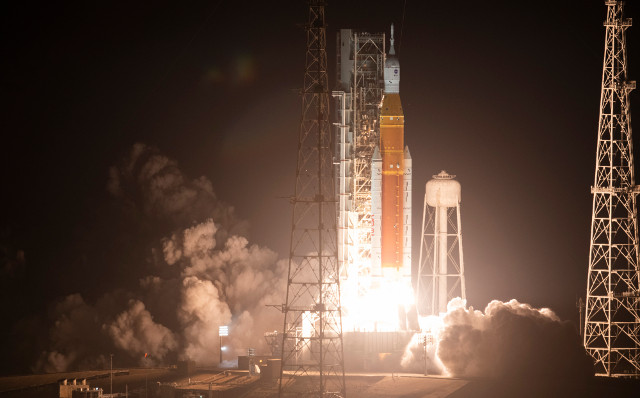
The Orion spacecraft blasting off atop the SLS to start the Artemis I mission (Photo NASA/Joel Kowsky)

A little while ago, NASA’s Orion spacecraft separated from the last stage, called the ICPS (Interim Cryogenic Propulsion Stage), of the Space Launch System (SLS), which blasted off almost two hours earlier from the Kennedy Space Center. The Orion entered the trajectory that will take it into the Moon’s orbit to carry out its mission which will last about 25 days. This is the first launch for the SLS and for the Orion in its full configuration. The ICPS also has the secondary mission of putting some CubeSat-class nanosatellites into orbit.

The Cygnus "Sally Ride" cargo spacecraf captured by the International Space Station's Canadarm2 robotic arm (Image NASA TV)

Northrop Grumman’s Cygnus spacecraft, launched last Monday, November 7, has just reached the International Space Station and was captured by the Canadarm2 robotic arm. Astronaut Nicole Mann, assisted by her colleague Josh Cassada, will soon begin the slow maneuver to move the Cygnus until it docks with the Station’s Unity module after about two hours.