NASA

The Soyuz MS-19 spacecraft leaves the International Space Station (Image NASA TV)

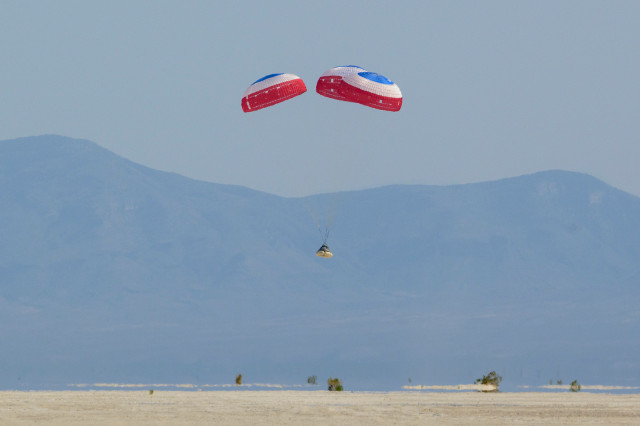
A little while ago, cosmonauts Anton Shkaplerov and Pyotr Dubrov and astronaut Mark Vande Hei returned to Earth on the Soyuz MS-19 spacecraft, which landed in Kazakhstan. Shkaplerov spent nearly 6 months on the International Space Station, where he arrived on October 5, 2021, as part of Expedition 65. Dubrov and Vande Hei arrived on April 9, 2021, as part of Expedition 64 and completed a long-duration mission.

Artist's representation of the magnetar SGR 1830 and its spots (Image NASA's Goddard Space Flight Center)

An article published in “The Astrophysical Journal Letters” reports a study on the magnetar cataloged as SGR 1830-0645, or simply SGR 1830, and spots on its surface that generated X-ray emissions. A team of researchers used the NICER telescope installed on the International Space Station to monitor the outbursts on the surface of SGR 1830 and the merger of three spots into one. More data was collected thanks to NASA’s Swift Space Telescope. The conclusion is that this is an activity that has similarities with the movements of tectonic plates on Earth. The magnetic field of the magnetar can cause its surface to deform, crack, and even melt even though it’s extremely hard. Spots are areas where Sun-like coronal loops connect to the surface.

Some of the images captured by the ACS instrument (Image NASA, ESA)

NASA and ESA celebrated the 20th anniversary of the installation of the Hubble Space Telescope’s ACS (Advanced Camera for Surveys) instrument with the publication of some images among the more than 125,000 captured during these twenty years of service. On March 7, 2002, astronauts James Newman and Mike Massimino installed the ACS during the space shuttle Columbia’s STS-109 mission. This instrument made a significant contribution to a lot of extraordinary astronomical research conducted using Hubble.

The Cygnus S.S. Piers Sellers cargo spacecraft captured by the Canadarm2 robotic arm (Image NASA TV)

Northrop Grumman’s Cygnus spacecraft, launched last Saturday, February 19, has just reached the International Space Station and was captured by the Canadarm2 robotic arm. Astronaut Raja Chari, assisted by his colleague Kayla Barron, will soon begin the slow maneuver to move the Cygnus until it docks with the Station’s Unity module after about two hours.

The Cygnus S.S. Piers Sellers cargo spacecraft blasting off atop an Antares rocket (Image NASA TV)

A little while ago, Northrop Grumman’s Cygnus spacecraft blasted off atop an Antares rocket from the Mid-Atlantic Regional Spaceport (MARS), part of NASA’s Wallops Flight Facility (WFF) on Wallops Island. After about nine minutes it successfully separated from the rocket’s last stage went en route to its destination. This is its 17th official mission, called NG-17 or CRS NG-17, to transport supplies to the International Space Station for NASA.