NASA

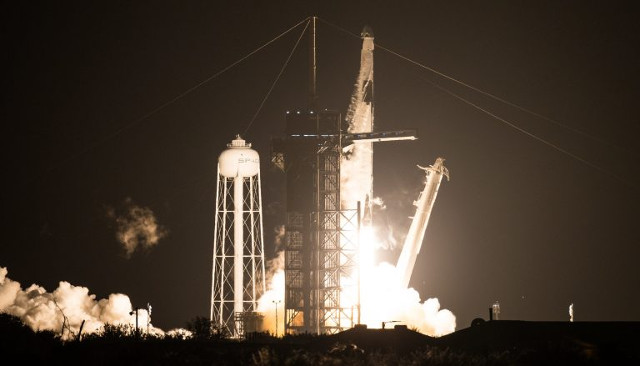
The Cygnus Kalpana Chawla starts its NG-14 mission blasting off atop an Antares rocket (Photo Wallops/Patrick Black)

A few hours ago Northrop Grumman’s Cygnus spacecraft blasted off atop an Antares rocket from the Mid-Atlantic Regional Spaceport (MARS), part of NASA’s Wallops Flight Facility (WFF) on Wallops Island. After about nine minutes it successfully separated from the rocket’s last stage went en route to its destination. This is its 14th official mission, called NG-14 or CRS NG-14, to transport supplies to the International Space Station for NASA.

Clouds on Jupiter seen by Juno (Image NASA/JPL-Caltech/SwRI/MSSS/Kevin M. Gill © CC BY)

Three articles, one published in the journal “Nature” and two published in the journal “Geophysical Research: Planets”, report various aspects of research on the clouds of the planet Jupiter. Three teams of researchers with various members in common, coordinated by the French CNRS’s Laboratoire Lagrange and NASA’s JPL, used data collected by the Juno space probe to analyze various aspects of the role of water in the violent storms in the Jovian atmosphere. Lightning strikes originate in a solution of water and ammonia, substances that can form a sort of hailstones, nicknamed mushballs by the researchers, which play a key role in the atmospheric dynamics of this gas planet.

The Crew Dragon Endeavor spacecraft after splashdown (Image NASA TV)

A little while ago SpaceX’s Crew Dragon Endeavor spacecraft ended its SpX-DM2 (SpaceX Demonstration Mission 2) or SpaceX Demo-2 mission on behalf of NASA by landing without problems. On board were American astronauts Bob Behnken and Doug Hurley, who finished SpaceX’s first crewed mission in the Atlantic Ocean off Pensacola, Florida. The Crew Dragon left the International Space Station almost a day earlier. Shortly after splashing down, the SpaceX ship called “Go Navigator” went to retrieve the Crew Dragon and its crew to transport them to the coast.

Mars Rover Perseverance and Mars Helicopter Ingenuity blasting off atop an Atlas V 541 rocket (Image NASA)

A little while ago NASA’s Mars 2020 mission blasted off atop an Atlas V 541 rocket from Cape Canaveral. Almost 58 minutes after launch, the spacecraft regularly separated from the rocket’s last stage went en route to the planet Mars, where is scheduled to enter its orbit in February 2021. There, the Mars Rover Perseverance and the Ingenuity helicopter will land on the red planet.

The Sun and its campfires seen by Solar Orbiter

ESA and NASA have published images captured by the Solar Orbiter space probe during its first Sun flyby. In this case, flying by means at a distance of about 77 million kilometers (48 million miles). During that maneuver, all its instruments were active after they were tested and commissioned despite the problems resulting from the Covid-19 pandemic with the difficulties for mission engineers and scientists. Among the first images, there are the ones of the so-called campfires, eruptions that are small by solar standards but are larger than many Earth nations.